










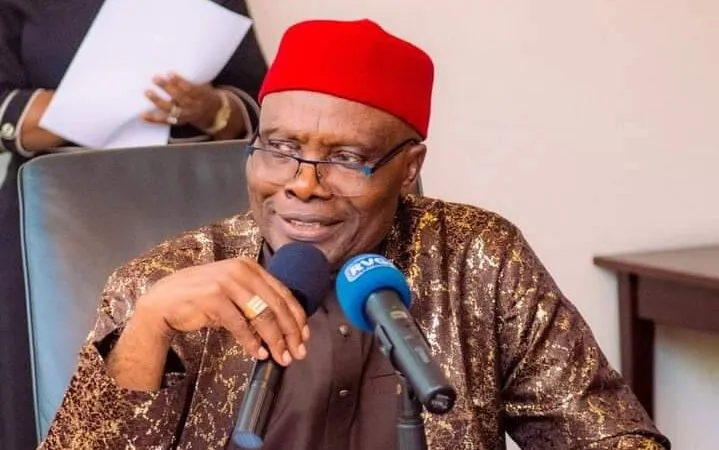
 The Peoples Democratic Party (PDP) has entered a fresh phase of internal uncertainty after its Board of Trustees (BoT), led by former Senate President Adolphus Wabara, stepped in to assume national leadership following a Supreme Court ruling that effectively nullified competing structures within the party’s hierarchy.
The move, announced in Abuja on Thursday, is being presented by party elders as an emergency stabilisation measure aimed at preventing a leadership vacuum in Nigeria’s main opposition party at a politically sensitive moment ahead of the 2027 general elections.
Court ruling triggers fresh power reset
The intervention follows a Supreme Court decision that invalidated the PDP national convention held in Ibadan between 15 and 16 November 2025, which had produced a National Working Committee (NWC) led by Kabiru Tanimu Turaki.
In the same judgment, the court upheld the suspension of key officials including Senator Samuel Anyanwu, Umar Bature, and Kamaldeen Ajibade, who had served as National Secretary, National Organising Secretary, and National Legal Adviser respectively.
While the full certified judgment is still being digested within party circles, the ruling has effectively deepened an already fractured leadership structure, leaving multiple factions without clear legal authority to operate.
BoT steps in under constitutional provision
Citing Section 32(5) of the PDP Constitution (2017 as amended), Wabara said the BoT was compelled to assume control to prevent paralysis at the national level of the party.
He argued that the invalidation of both the Turaki-led and previously existing caretaker-aligned structures created a constitutional gap that only the BoT is empowered to temporarily bridge.
According to him, actions previously taken by the suspended officials — including the appointment of an Acting National Chairman and the organisation of internal party processes — are now void as a consequence of the court ruling.
The BoT’s takeover, while framed as procedural, effectively places one of the party’s most influential advisory organs in direct control of its day-to-day administration, at least in the interim.
A party repeatedly tested by internal fractures
The PDP’s latest crisis is part of a longer pattern of internal disputes over leadership legitimacy, convention outcomes, and control of the party’s national structure — tensions that have repeatedly spilled into the courts in recent years.
Since losing federal power in 2015, the party has struggled with recurring factional disputes, often centred on competing interpretations of its constitution and contested conventions. These conflicts have, in several instances, weakened its ability to present a unified front during elections.
The current dispute is particularly significant because it comes less than two years before the 2027 general elections, a period when opposition cohesion is typically expected to strengthen rather than fragment.
What the BoT plans next
Wabara said the BoT will move quickly to stabilise the party by convening an emergency National Executive Committee (NEC) meeting. The proposed NEC session is expected to set up an interim National Working Committee (NWC) that will oversee party administration and prepare for upcoming electoral activities.
He also directed all PDP staff to resume duties at the national secretariat in Abuja under BoT supervision, signalling an attempt to restore operational normalcy despite the leadership dispute.
Beyond administration, the BoT says it will prioritise reconciliation among rival factions — a task that has historically proven difficult for the party’s internal arbitration structures.
What this means going forward
The immediate implication is that the PDP has, once again, shifted into an emergency governance mode, with an unelected interim structure stepping in to manage affairs. While this may restore short-term order, it also raises longer-term questions about internal democracy and the enforceability of party conventions.
For members, especially those aligned with different factions, the ruling effectively resets ongoing political calculations ahead of candidate selection processes and strategic positioning for 2027.
What remains unclear is whether all stakeholders will accept the BoT’s authority or whether fresh legal and political disputes will emerge from the ruling itself — a possibility that could prolong instability within the opposition party at a critical electoral juncture.