










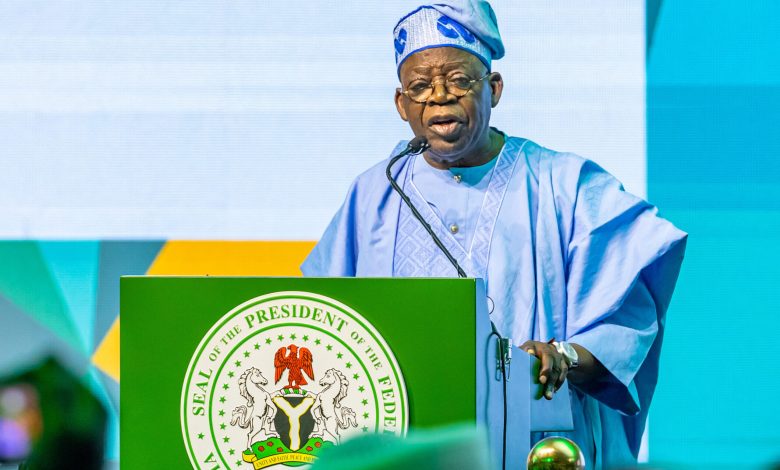
President Bola Ahmed Tinubu has again pledged that his administration will defeat banditry and terrorism, offering a message of resolve at a time when public confidence in the country’s security architecture remains fragile.
Speaking on Saturday at the commissioning of the Gateway International Airport in Iperu, Ogun State, Tinubu said his government would “win over banditry and terrorism,” while promising increased investment in citizens. The event, hosted by Ogun State Governor Dapo Abiodun, doubled as a showcase of infrastructure projects spanning transport, agriculture, and security.
His remarks come less than a week after he travelled to Jos to commiserate with victims of a deadly attack in the Angwan Rukuba area, where at least 28 people were killed by gunmen on March 29. The juxtaposition of those two moments—mourning victims of violence and projecting optimism at a development ceremony—captures the central tension facing Tinubu’s presidency.
A Familiar Promise, Renewed Pressure
Tinubu’s assurance is not new. Since taking office in 2023, his administration has repeatedly vowed to restore security across regions plagued by banditry in the North-West, insurgency in the North-East, and communal violence in the Middle Belt.
What is different now is the urgency. Recent attacks, including the Jos killings, have reinforced a perception that insecurity is not receding at the pace many Nigerians expected. While the President pointed to the deployment of security vehicles at the Ogun event as evidence of commitment, such symbolic gestures often struggle to convince communities facing daily threats.
Security analysts say the real test lies less in equipment procurement and more in coordination between federal forces, intelligence services, and state-level actors—areas where gaps have historically persisted.
Infrastructure as Strategy
The commissioning of the Gateway International Airport—highlighted by Tinubu as having an independent power supply—signals another dimension of the administration’s approach: linking infrastructure development to broader economic stability.
The President also unveiled complementary initiatives, including mobility projects such as 1,000 electric bikes, which he described as a forward-looking response to transportation needs.
There is a strategic calculation here. By promoting economic activity and connectivity, the government hopes to address some of the structural drivers of insecurity, particularly youth unemployment and regional isolation. Tinubu’s praise for Nigerian youth as “committed, brilliant and working hard” reflects this framing.
However, the connection between infrastructure and immediate security outcomes is indirect. For many Nigerians, especially in rural and conflict-prone areas, physical safety remains a more urgent concern than long-term development gains.
What Is Known—and What Isn’t
The President did not outline specific new security measures or timelines during his remarks. It remains unclear whether his renewed assurance will be backed by changes in military strategy, policing reforms, or increased funding for intelligence operations.
Similarly, while he referenced ongoing investments in security vehicles, no detailed breakdown of deployment plans or impact assessments was provided.
Implications for Citizens
For ordinary Nigerians, the stakes are immediate. Persistent insecurity affects farming cycles, food prices, school attendance, and internal migration. In regions most affected by banditry and insurgency, daily life is shaped by the risk of attack or abduction.
If the administration’s strategy leans heavily on infrastructure and economic optimism without visible improvements in frontline security, public frustration could deepen.
What to Watch Next
Tinubu’s latest assurance raises key questions that will define the coming months:
- Whether there will be a measurable reduction in attacks across high-risk states
- If new security policies or command structures will be introduced
- How federal and state governments will coordinate responses more effectively
For now, the President’s message is one of confidence. But in a country where similar promises have been made by successive administrations, Nigerians are likely to judge this one not by its tone—but by results on the ground.