










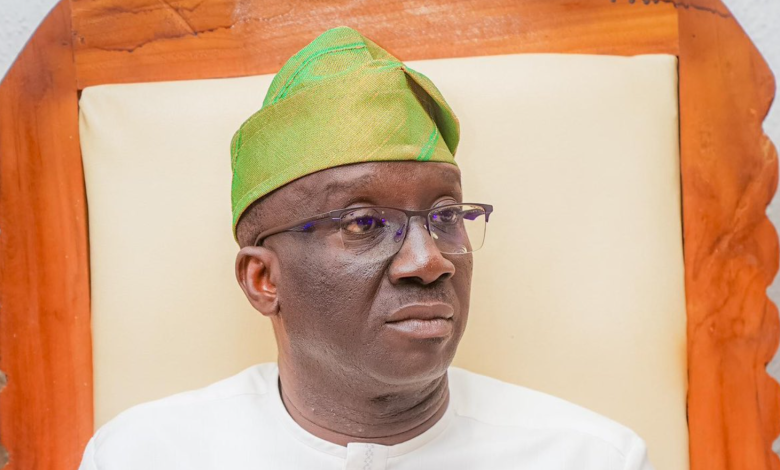
 Governor Monday Okpebholo of Edo State has declared that President Bola Tinubu will enjoy overwhelming support in the state during the 2027 presidential election, insisting that residents are satisfied with the federal government’s interventions and will vote en masse for his re-election.
Speaking during an interview on Channels Television’s Politics Today on Thursday night, Okpebholo framed the expected outcome as a reflection of what he described as visible federal backing for development projects across the country through state-level execution.
He went further to predict a landslide outcome, claiming that the state already has “2.5 million votes on the streets” in support of the president — a remark that has already drawn attention given Edo State’s historically competitive electoral environment.
Claims of support tied to federal funding
According to the governor, the enthusiasm he sees in Edo is driven largely by what he described as increased financial support from the federal government under President Tinubu.
“We are doing the work, because of the money Tinubu is releasing to us to work for him,” he said, linking ongoing state activities to federal allocations and intervention programmes.
His comments reflect a broader political messaging trend among some state governors aligned with the ruling All Progressives Congress (APC), who have increasingly tied local development narratives to federal leadership ahead of the next election cycle.
Revisiting the 2023 election outcome
Okpebholo also revisited the 2023 presidential election outcome in Edo State, where Labour Party candidate Peter Obi performed strongly. He attributed Obi’s victory in the state to dissatisfaction with the administration of former governor Godwin Obaseki, suggesting that voters used the ballot as a form of protest.
“Peter Obi defeated Tinubu last time because the then governor was not working,” he said, adding that voter behaviour was shaped more by local governance grievances than party alignment at the time.
Political context and what is at stake
Edo State has long been considered a politically competitive battleground, often influenced by shifting alliances between national and local political actors. The 2023 election underscored this volatility, with opposition candidates making significant inroads in urban and youth-heavy constituencies.
Okpebholo’s comments now signal an early attempt by the APC leadership in the state to consolidate political messaging ahead of 2027, particularly by linking federal support to anticipated electoral outcomes.
However, claims of fixed or predetermined vote counts — such as the governor’s reference to “2.5 million votes already on the streets” — are often viewed cautiously by election observers, given Nigeria’s history of highly contested and unpredictable voting patterns.
Why this matters now
The remarks come at a time when political positioning for 2027 is gradually beginning to take shape, despite ongoing national concerns around inflation, insecurity, and public trust in governance.
For ordinary voters in Edo, the key issue will likely remain whether federal and state-level promises translate into tangible improvements in jobs, infrastructure, and cost of living — rather than early projections of electoral outcomes.
What to watch next
As the political season slowly builds momentum, attention will focus on whether opposition parties in Edo respond to Okpebholo’s assertions and how voter sentiment evolves in the coming months.
For now, the governor’s comments add to an increasingly early and competitive political narrative around 2027, even as the real electoral dynamics remain far from settled.