









 Political alignments ahead of Nigeria’s 2027 elections are becoming clearer — and in Kano, one of the country’s most influential voting blocs, the ruling Bola Ahmed Tinubu has secured a significant show of support. But alongside that endorsement came a message that could reshape internal party calculations: while top figures may enjoy early backing, most aspirants will still have to earn their tickets through party processes.
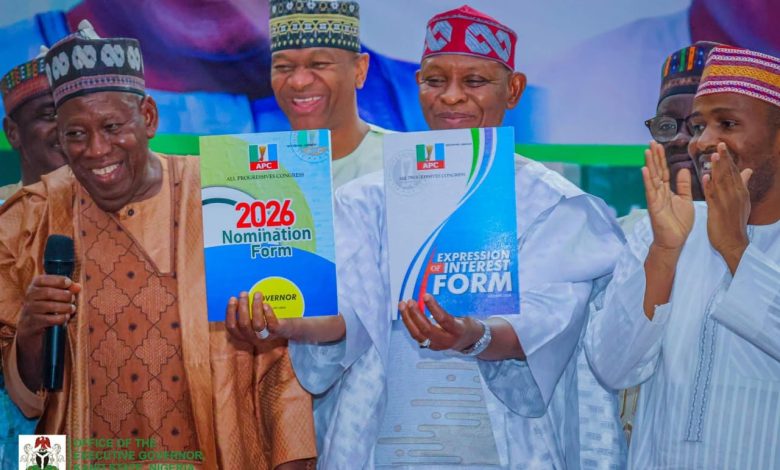
At a stakeholders’ meeting in Kano on Thursday, the All Progressives Congress formally endorsed President Tinubu as its sole presidential candidate for 2027, while also presenting expression of interest and nomination forms to Governor Abba Kabir Yusuf as a symbolic endorsement for a second term bid. Former APC National Chairman Abdullahi Umar Ganduje personally handed over the forms, describing Yusuf as the party’s consensus choice for governor.
Elite consensus at the top, contest below
The significance of the meeting extends beyond endorsements.
While Tinubu and Yusuf were effectively adopted as consensus candidates, party leaders explicitly ruled out automatic tickets for lawmakers and other aspirants. Those positions, stakeholders said, will be decided through internal mechanisms — especially consensus-building, a method often used in Nigerian party politics to avoid bruising primaries.
That distinction matters.
It suggests Kano APC is attempting to balance two competing priorities: projecting unity around its most powerful figures while containing tensions among ambitious lower-level contenders who may resist being shut out of the race.
In practical terms, it is a recognition that political stability at the top does not always translate to peace at the grassroots, where ticket battles are often fiercest.
Why Kano matters nationally
Kano remains one of Nigeria’s most politically consequential states because of its voting strength, strategic location in the North-West, and outsized influence on national electoral outcomes. Any early consolidation behind Tinubu from Kano’s political establishment strengthens his position as campaigning for 2027 gradually takes shape.
The endorsement also reinforces the growing pattern in Nigerian politics where re-election bids are being framed well ahead of formal electoral timelines — not necessarily through official campaigns, but through symbolic acts of loyalty, endorsements, and strategic coalition-building.
For ordinary citizens, however, the optics may be received differently.
At a time when Nigerians are grappling with inflation, rising living costs, insecurity, and economic uncertainty, early positioning for 2027 may deepen public concern that political actors are turning attention toward succession politics while pressing governance challenges remain unresolved.
Questions around the emerging alliance
What is publicly known is that Kano APC stakeholders unanimously backed Tinubu and ceremonially presented nomination forms to Governor Yusuf at Thursday’s meeting. Ganduje described the move as the outcome of collective agreement among party leaders, while party chairman Umar Haruna Doguwa said members had also planned to purchase forms for Tinubu as a show of support.
What remains unclear is how this consensus will hold when legislative tickets, local power blocs, and competing ambitions begin to surface in the months ahead.
That is often where unity declarations face their toughest test.
What to watch next
Attention will now shift to whether Kano APC can manage internal competition without factional cracks — especially as negotiations over consensus candidates for Senate, House of Representatives, and state assembly seats intensify.
For Tinubu, the endorsement is a political boost.
For Kano APC, the harder work — keeping the party united while managing ambition — is only just beginning.