










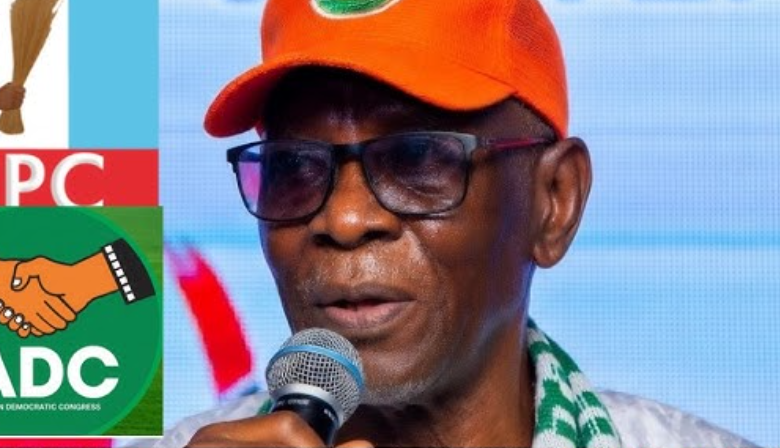
 What began as a routine national convention of the African Democratic Congress (ADC) in Abuja briefly veered into theatre when a familiar political reflex slipped into the open. During his address to party delegates, former APC national chairman John Odigie-Oyegun mistakenly shouted “APC” — the name of his former party — before catching himself mid-sentence.
The moment, though fleeting, cut through the formality of the gathering and drew laughter from delegates, offering a rare glimpse into the lingering identities that often follow Nigerian politicians across party lines.
A slip that drew laughter — and reflection
Realising the error almost immediately, Oyegun paused and asked, “No, no, did I just say APC?” The hall erupted in amusement, momentarily interrupting proceedings.
Among those who seized the moment was Dino Melaye, who quipped that Oyegun needed to “seek refuge from the devil,” a remark that further lightened the mood and underscored the camaraderie — and rivalry — that often coexist in Nigerian political spaces.
Oyegun himself leaned into the humour, acknowledging that remnants of his past political affiliation might still linger. He joked about needing a “strong purgative” to rid himself of the reflex, before steering the conversation back to party business.
Beyond humour: the weight of political history
While the incident was widely treated as comic relief, it also touched a deeper nerve in Nigeria’s political culture — the fluidity of party allegiance and the persistence of old loyalties.
Oyegun’s prominence within the All Progressives Congress, where he once served as national chairman, makes his current role in the African Democratic Congress particularly significant. His slip, though accidental, highlights how political transitions in Nigeria are often less about ideological shifts and more about strategic repositioning.
For many observers, the moment reinforced a long-standing critique: that party platforms in Nigeria remain weakly defined, allowing politicians to move between them with minimal friction — and sometimes, as seen in Abuja, with occasional lapses.
Reasserting ADC’s ambitions
Despite the distraction, Oyegun used his speech to deliver a pointed message about the ADC’s intentions ahead of the 2027 general elections. He declared that the party is preparing itself as a credible alternative to the current ruling establishment, insisting that “it is not going to be business as usual.”
His remarks suggest an attempt by the ADC to consolidate high-profile defectors and reposition itself in a political landscape dominated by larger parties. Whether that ambition translates into electoral strength, however, remains uncertain.
Public reaction and political implications
The episode quickly gained traction online, with Nigerians offering mixed interpretations. Some dismissed it as a harmless verbal slip, while others saw it as emblematic of a broader issue — the enduring influence of former political affiliations on present alignments.
What is clear is that moments like this resonate beyond the hall where they occur. For voters increasingly sceptical of political defections, such incidents can reinforce perceptions that party switching is driven more by opportunity than conviction.
What to watch
As the 2027 elections begin to take shape, attention will likely focus on whether parties like the ADC can move beyond symbolic moments and articulate a distinct political identity.
For Oyegun and others who have crossed party lines, the challenge is not just to avoid rhetorical slips, but to convince Nigerians that their current platforms represent more than a change of name.