







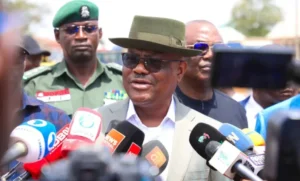
 A routine inspection of road projects in Abuja on Thursday turned into a sharp political exchange, as the Minister of the Federal Capital Territory, Nyesom Wike, publicly rebuked former Vice President Atiku Abubakar, dismissing his criticisms of the current administration and questioning his electoral track record.
Wike’s remarks, delivered while touring infrastructure sites across the capital, highlight a deepening rivalry within Nigeria’s opposition political space—one that is increasingly spilling into governance discourse.
Clash over performance and credibility
The minister’s comments were in direct response to Atiku’s recent assertion that the present government has failed to deliver meaningful benefits to Nigerians. Wike rejected the claim outright, describing Atiku as a “serial contestant and loser,” and suggesting he would likely seek the presidency again in 2031 despite repeated defeats.
He also challenged Atiku to assess the state of Abuja during his time in office compared to current conditions, arguing that ongoing infrastructure upgrades demonstrate measurable progress.
The exchange reflects more than personal animosity. It underscores a broader contest over political credibility ahead of future electoral cycles, particularly as key actors reposition themselves after the 2023 elections.
Infrastructure as political capital
Wike used the occasion to spotlight ongoing road projects, framing them as evidence of the administration’s performance. He said work on the Airport–Kuje road is nearing completion, with a section of the bridge expected to open before the end of May. He also noted that the first phase of the Kuje–Gwagwalada dualisation project—spanning roughly seven kilometres—is progressing on schedule.
According to the minister, these projects are part of a deliberate effort to expand Abuja’s urban footprint and reduce congestion in the city centre. He projected that improved connectivity would accelerate Kuje’s transition from a satellite town into a viable residential and commercial hub.
For residents, such developments could mean shorter commute times, lower housing pressure in central districts, and new economic opportunities in outlying areas—if projects are completed as planned.
Denial of political interference
Wike also addressed allegations by the African Democratic Congress (ADC) that officials of the FCT administration attempted to obstruct its convention at the Rainbow Event Centre. He denied any involvement, stating he was unaware of the venue and insisting that no directive was issued to interfere.
He further challenged the party to provide evidence of any formal request to use Eagle Square, suggesting that due process may not have been followed.
Context: rivalry and realignment
The friction between Wike and Atiku is rooted in the aftermath of the 2023 general elections, when internal divisions weakened the opposition. Wike, a former governor of Rivers State, broke ranks with his party leadership during the campaign period, a move that reshaped alliances and continues to influence political positioning.
Atiku, who has contested multiple presidential elections over the past two decades, remains a central figure in opposition politics, even as questions persist about his future ambitions.
What is known — and what is not
Wike’s statements are on record from his Thursday inspection tour, and project timelines he cited are consistent with earlier government briefings. However, there is no independent verification yet on whether all listed infrastructure projects will meet the stated completion deadlines.
Similarly, the ADC’s allegations of interference remain contested, with no publicly available documentation confirming either side’s claims.
What to watch next
The immediate test will be whether the FCT administration delivers on its infrastructure promises within the timelines announced. Successful completion could strengthen Wike’s governance credentials and reshape Abuja’s development pattern.
Politically, the rhetoric signals that alignments ahead of the next election cycle are already taking shape. If the tone of exchanges between figures like Wike and Atiku is any indication, the battle for narrative control—over performance, credibility, and leadership—has quietly begun.
For citizens, the key question is whether this political sparring translates into tangible improvements in daily life—or remains another layer of Nigeria’s enduring power struggle.