










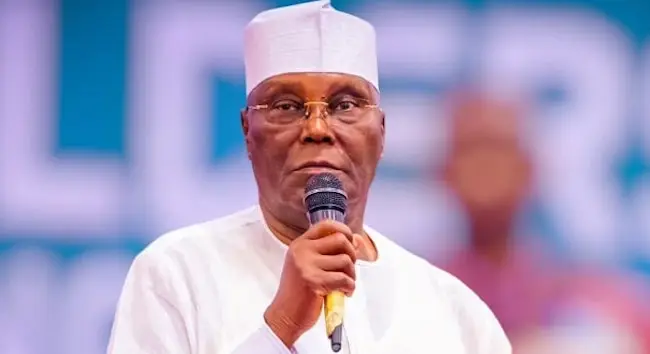
 Nigeria’s fragile political consensus on power rotation has come under renewed strain, with allies of former Vice President Atiku Abubakar accusing the presidency of attempting to elevate a political convention into an unwritten rule of governance ahead of the 2027 elections.
The dispute, which played out publicly on Thursday, reflects a deeper contest over who gets to define the rules of political succession in a country where informal agreements often carry as much weight as constitutional provisions.
Clash over zoning and constitutional limits
The latest exchange was triggered by remarks from Bayo Onanuga, spokesperson to President Bola Ahmed Tinubu. Responding to Atiku’s recent appearance on Arise TV, Onanuga argued that Tinubu “must complete eight years” in office, citing the long-standing North-South power rotation principle.
According to him, since a northern president has completed two terms, political balance requires the South to retain power until 2031.
But in a sharply worded rebuttal posted on X, Atiku’s spokesperson, Phrank Shaibu, rejected that argument as an attempt to “rewrite the Constitution” and suppress opposition participation.
“Power rotation is a political convention, not a constitutional decree,” Shaibu said, adding that no presidential aide has the authority to turn zoning into a binding rule or use it to “silence credible opposition.”
Why this argument matters now
At stake is more than a war of words. The disagreement signals the early shaping of narratives ahead of 2027, where questions of fairness, regional balance, and constitutional rights are likely to dominate campaign rhetoric.
Nigeria’s Constitution does not mandate rotational presidency between North and South. Instead, zoning has functioned as an informal mechanism within political parties — particularly the Peoples Democratic Party (PDP) — to manage the country’s deep ethnic and regional divisions.
However, as this latest exchange shows, what was once a party-level arrangement is increasingly being framed as a broader national expectation — a shift that could limit political competition if left unchallenged.
Historical fault lines
Since the return to democracy in 1999, power has alternated between northern and southern leaders, though not always smoothly. The death of President Umaru Musa Yar’Adua in 2010 and the subsequent rise of Goodluck Jonathan disrupted that pattern, triggering political tensions that still echo today.
More recently, internal disputes over zoning contributed to fractures within major parties during the 2023 elections. The ruling All Progressives Congress (APC) and the opposition PDP both faced internal criticism over how they handled the North-South balance.
Shaibu alluded to this history, accusing those now defending zoning of selectively applying it when politically convenient — a charge that underscores the inconsistency that has long plagued the arrangement.
Impact on citizens and political stability
For ordinary Nigerians, the debate may appear elite-driven, but its consequences are tangible. When political competition is framed around regional entitlement rather than policy, governance priorities risk being sidelined.
There is also the danger that hardening positions on zoning could deepen regional divisions, particularly at a time when the country is already grappling with economic strain, insecurity, and declining public trust in institutions.
If political actors begin to treat power rotation as obligatory rather than voluntary, it could narrow the field of candidates and weaken democratic choice.
What is clear — and what is not
What is established is that a senior presidential aide has publicly endorsed the idea of a full eight-year tenure for Tinubu based on zoning logic, and that Atiku’s camp has forcefully rejected that position.
What remains unclear is whether this reflects an official policy direction of the presidency or simply a political argument advanced by its spokesperson. There has been no formal constitutional proposal or legislative move to entrench zoning as law.
What to watch ahead of 2027
This exchange is likely an early indicator of how the 2027 contest will be framed: not just as a battle of candidates, but as a debate over the rules themselves.
Key questions will include whether major parties formally recommit to zoning, whether legal interpretations of constitutional rights to contest elections are tested, and how voters respond to arguments rooted in regional equity versus merit.
For now, the message from Atiku’s camp is clear — the Constitution, not political tradition, will be the ground on which the next electoral battle is fought.