







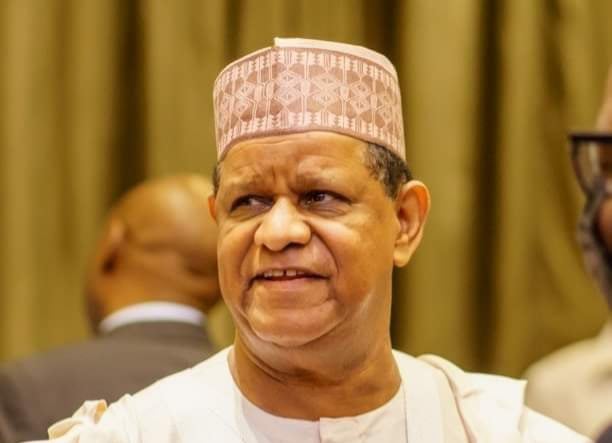
 As political parties begin early positioning ahead of the 2027 general election, presidential hopeful Mohammed Hayatudeen has pushed back against growing conversations around zoning, arguing that the debate is increasingly disconnected from the everyday realities facing Nigerians.
Speaking during Political Paradigm on Channels Television, Hayatudeen said the fixation on which region should produce the next president risks reducing a national emergency into a narrow political calculation at a time when millions are struggling with insecurity, inflation and economic uncertainty.
“The mother who cannot afford to buy food at the market, and the father who cannot send his child to school — what has any of that got to do with zoning?” he asked, framing his criticism around the widening gap between elite political debates and the immediate concerns of ordinary citizens.
Shifting the conversation from power-sharing to survival
Hayatudeen’s remarks come at a time when political alignments for 2027 are quietly gathering pace, with familiar conversations about North-South power rotation already shaping party calculations. In Nigeria’s political history, zoning has often been presented as a mechanism for balancing regional interests and maintaining national cohesion in a deeply diverse federation.
But critics have long argued that while zoning may settle elite negotiations, it does little on its own to guarantee competent governance.
Hayatudeen appears to be positioning himself firmly within that critique. His argument is that leadership should be judged by competence, vision and empathy rather than geographic origin — a message likely designed to appeal to younger voters and urban Nigerians increasingly frustrated by identity-driven politics.
“It doesn’t matter where you come from,” he said. “What matters is that you have the capacity, the skill, the vision and the deep empathy to deliver for every single Nigerian.”
Security and economic hardship at the centre
The economist also tied Nigeria’s worsening security crisis to decades of economic mismanagement, suggesting that armed violence, kidnappings and social instability are symptoms of deeper structural failures.
By citing abduction figures and rising hardship, Hayatudeen sought to redirect attention to what many Nigerians confront daily: unsafe highways, shrinking purchasing power, rising unemployment and a cost-of-living crisis that continues to squeeze households.
For ordinary citizens, this framing matters because it shifts the political test for 2027 away from symbolic representation toward practical governance: Can leaders improve security? Can they create jobs? Can they stabilise prices and restore confidence in public institutions?
Those questions are likely to weigh more heavily on voters than long-running arguments over regional entitlement.
A familiar criticism of shrinking political space
Hayatudeen also raised concerns about what he described as the narrowing of democratic space, alleging that state instruments and political surrogates are being used to weaken genuine opposition and limit electoral choice.
That claim reflects a broader concern in Nigeria’s opposition politics — that smaller parties face steep institutional and financial obstacles in challenging dominant political blocs like the All Progressives Congress and the Peoples Democratic Party.
What remains unclear, however, is the specific evidence behind Hayatudeen’s allegation of deliberate political suppression. No direct examples were cited during the interview, making that aspect of his criticism an assertion rather than an independently verified claim.
What to watch ahead of 2027
Hayatudeen’s intervention is significant not merely because he is seeking the presidential ticket of the African Democratic Congress, but because it signals an emerging line of debate within opposition politics: whether Nigeria’s next election should be fought on regional balancing or on measurable governance failures.
As campaign rhetoric builds, voters will likely hear more about zoning. But with inflation biting, insecurity spreading and economic confidence fragile, candidates who can convincingly address daily hardship may ultimately command more public attention than those relying solely on political arithmetic.