









 Tensions around the control of local government funds in Osun State escalated on Wednesday as protesters marched on the State High Court in Osogbo, signalling a widening institutional conflict that now threatens to test the limits of judicial authority and political restraint in the state.
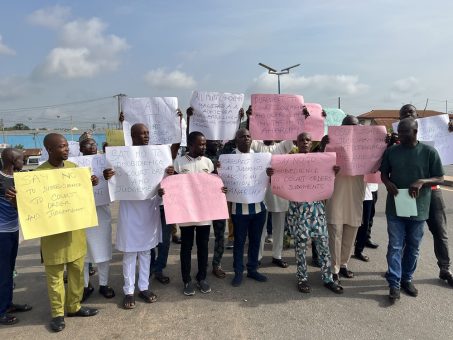
The demonstrators, who moved from the Government House to the court premises, were reacting to what they described as contradictory legal actions in an ongoing dispute involving local council finances and the role of a commercial bank accused of facilitating controversial fund releases.
Clash of court decisions
At the centre of the crisis is a legal tussle between the Osun State Government and United Bank for Africa (UBA), which the state accused of releasing funds tied to local government accounts in a manner that allegedly enabled the reinstatement of All Progressives Congress (APC)-aligned council chairmen.
A Magistrate Court had earlier ordered the arrest of UBA executives in connection with the मामला. However, the Osun State High Court, presided over by Justice Matthias Agboola, subsequently issued an ex parte order quashing the criminal proceedings against the bank and its officials.
Despite that ruling, proceedings at the Magistrate Court reportedly continued — a development that has triggered alarm among the reinstated council officials and their supporters.
Protest over judicial consistency
Protesters gathered at the Lameco area of Osogbo before proceeding to the High Court, carrying placards demanding adherence to court rulings and warning against what they termed judicial disobedience.
Security personnel were deployed to prevent the situation from degenerating, though no violence was reported as of the time of filing this report.
Speaking during the protest, Hon. Maaroof Ogundipe, who represented the reinstated council executives, warned that ignoring a High Court decision in favour of lower court proceedings could erode confidence in the judiciary.
“It is worrisome when court decisions appear to be undermined,” he said, adding that the group may escalate the matter to the National Judicial Council (NJC).
Legal and political undercurrents
The dispute reflects deeper political fault lines in Osun State, where control of local government structures has been fiercely contested between rival parties. Local government funds — often a significant source of political influence — remain at the heart of that struggle.
Chairman of Ejigbo LCDA, Olayanju Kolapo, noted that multiple rulings, including a Supreme Court judgment delivered in December 2025, had already addressed key aspects of the القضية. He warned that selective compliance with court decisions risks creating confusion within the judiciary itself.
Legal analysts say the situation raises fundamental questions about judicial hierarchy and enforcement. Under Nigeria’s legal system, lower courts are bound by decisions of higher courts — making any deviation a potential constitutional issue rather than a routine procedural disagreement.
What this means for residents
For ordinary citizens, the implications extend beyond legal technicalities. Prolonged disputes over local government funds can disrupt grassroots governance, delay salaries, stall community projects, and deepen political tensions at the local level.
The visible breakdown in judicial coherence may also weaken public trust in institutions meant to resolve disputes peacefully — a risk in a state already navigating political divisions.
What is known — and what remains unclear
It is confirmed that the High Court nullified the Magistrate Court proceedings against UBA and its officials. It is also confirmed that proceedings reportedly continued at the lower court despite that ruling.
However, it remains unclear why the Magistrate Court has not halted its actions, whether there are procedural nuances not yet disclosed, and what immediate steps judicial authorities will take to resolve the apparent conflict.
What to watch next
Attention is likely to shift to the response of the National Judicial Council, should a formal petition be filed, and whether it will intervene to clarify the situation.
Equally important will be the reaction of the Osun State Government and the judiciary’s internal mechanisms for resolving conflicting orders.
For now, the протест marks more than a legal dispute — it is a visible sign of institutional strain, with consequences that could extend well beyond Osogbo if not swiftly addressed.