








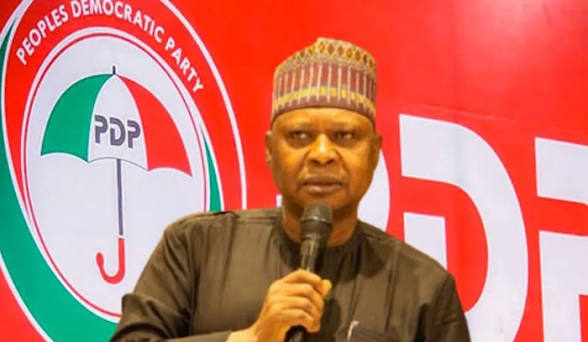
 Nigeria’s main opposition party, the Peoples Democratic Party, has moved deeper into uncertainty after a faction aligned with Seyi Makinde announced the appointment of Kabiru Turaki as chairman of its interim National Working Committee, a development likely to sharpen divisions within a party already struggling with a prolonged internal power battle.
The decision was taken on Monday during what the Makinde-backed bloc described as its 103rd National Executive Committee meeting in Abuja, where Turaki, a Senior Advocate of Nigeria, was unveiled as head of a 13-member interim leadership team tasked with steering the affairs of that faction pending further political and legal developments.
Supreme Court ruling reshapes PDP power struggle
Monday’s announcement comes just days after the Supreme Court of Nigeria delivered a major judicial blow to the same bloc by nullifying the outcome of the party’s national convention held in Ibadan last November.
That convention had produced Turaki as substantive national chairman. But the apex court’s ruling invalidated the convention’s outcome, effectively removing legal standing from the officers elected at the gathering and reopening the fierce contest over who controls the PDP’s national machinery.
Rather than retreat, the Makinde-aligned camp has opted for a constitutional workaround.
Invoking Section 31 of the PDP Constitution, the faction said it secured the signatures of two-thirds of NEC members to constitute an interim committee — a move intended to preserve its organisational structure despite the court ruling.
What this means for the PDP
The immediate implication is that the PDP’s leadership crisis may now shift from internal disagreement to a full-blown legitimacy battle.
With competing centres of influence emerging, questions are likely to intensify over which faction speaks for the party in official dealings, candidate selection processes, and negotiations ahead of future elections. For ordinary party members, especially at state and grassroots levels, the uncertainty could weaken mobilisation efforts and deepen factional loyalties at a time when the opposition is expected to present a coherent challenge to the ruling party.
Political analysts have long warned that unresolved leadership disputes within the PDP risk eroding public confidence in its ability to function as a credible national alternative.
A familiar cycle of internal conflict
Since losing power at the federal level in 2015, the PDP has repeatedly battled internal fractures — from disputes over zoning arrangements and presidential primaries to rival claims over party offices and legal tussles over convention outcomes.
The latest episode reflects a wider pattern in Nigerian party politics, where leadership contests often end up in courtrooms, creating parallel structures that weaken internal democracy and blur institutional authority.
What remains unclear
While the Makinde-backed faction insists the interim arrangement is constitutionally valid, it remains unclear whether rival blocs within the PDP recognise the committee’s authority.
It is also not yet confirmed whether the party’s full national structure, including all governors, the Board of Trustees, and National Assembly caucuses, is aligned behind the move or whether Monday’s Abuja meeting represented only one power centre within the broader PDP coalition.
What to watch next
Attention will now turn to reactions from other influential figures within the party and whether fresh legal challenges emerge over the interim committee’s legitimacy.
For the PDP, the bigger question is no longer just who leads the party — but whether it can resolve its internal war quickly enough to remain politically competitive on the national stage.