








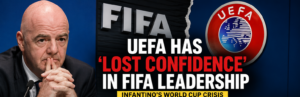
FIFA President Gianni Infantino is facing one of the most serious political challenges of his presidency after UEFA publicly declared that it has “lost confidence” in FIFA’s leadership. The statement, which followed the collapse of FIFA’s controversial World Cup commercial rights proposal, has triggered a major governance crisis that could reshape the balance of power in international football.
The dispute is not simply about one failed commercial plan. It reflects growing frustration among Europe’s football leaders over the way FIFA has been managed under Infantino, with concerns ranging from transparency and financial decision-making to the concentration of power within the organization.
For the first time in several years, the relationship between FIFA and UEFA appears to have entered a period of open confrontation, with significant implications for future World Cup tournaments, international football governance, and the race for influence ahead of the next FIFA presidential cycle.
Why UEFA says it has lost confidence
The crisis erupted after FIFA explored a proposal involving the commercialization and potential private investment in future World Cup rights. Reports indicated that the governing body considered a major restructuring of its commercial operations, including discussions involving outside investors and long-term revenue arrangements linked to FIFA competitions.
UEFA strongly opposed the proposal, arguing that such a move lacked transparency and had not been properly discussed with key stakeholders. European football officials were particularly concerned that decisions affecting the World Cup — the most valuable tournament in global sport — were being pursued without adequate consultation.
UEFA’s criticism went beyond the proposal itself. Its leadership questioned FIFA’s governance standards and suggested that confidence in Infantino’s administration had significantly deteriorated.
The language used by UEFA was unusually direct, making it one of the strongest public rebukes of a FIFA president in recent memory.
The World Cup commercial rights controversy explained
At the center of the dispute is FIFA’s attempt to expand revenue streams ahead of the increasingly expensive World Cup cycle.
The 2026 FIFA World Cup, which will be hosted by the United States, Canada, and Mexico, is the largest tournament in history, featuring 48 teams. The expansion has dramatically increased the commercial value of broadcasting rights, sponsorships, ticket sales, and digital partnerships.
FIFA has argued that maximizing commercial income is necessary to fund global football development, support smaller associations, and finance future competitions.
Critics, however, feared that bringing private investment into the commercial structure of the World Cup could reduce transparency and potentially shift financial influence away from football’s traditional governing institutions.
UEFA reportedly viewed the proposal as a fundamental governance issue rather than merely a financial one.
How the relationship between FIFA and UEFA deteriorated
The tension between FIFA and UEFA has been building for years.
One of the major flashpoints has been FIFA’s increasingly ambitious expansion strategy. Infantino has championed larger tournaments, including the expanded Club World Cup and the 48-team men’s World Cup, arguing that football should generate more revenue globally rather than remain concentrated in Europe.
UEFA has often responded cautiously, concerned about fixture congestion, player welfare, and FIFA’s growing commercial ambitions.
European football officials also believe that UEFA contributes a disproportionate share of global football revenue and influence, giving them a significant stake in how FIFA operates.
The latest controversy appears to have transformed a simmering rivalry into a more direct institutional conflict.
Why this matters for Gianni Infantino
Infantino has led FIFA since 2016 and has overseen significant financial growth during his presidency.
Supporters credit him with expanding FIFA’s global reach, increasing investment in developing football nations, and modernizing parts of the organization.
His critics argue that decision-making has become increasingly centralized and that FIFA has not been sufficiently transparent on major commercial and governance issues.
UEFA’s loss of confidence is politically significant because Europe remains the most influential football confederation in the world. Many of the world’s richest clubs, leagues, broadcasters, and sponsors are based in Europe.
A prolonged breakdown in relations between FIFA and UEFA could weaken Infantino’s authority even if he retains strong support from many national associations outside Europe.
The governance questions
Several governance concerns have emerged from the dispute.
Transparency
UEFA has questioned whether FIFA adequately informed stakeholders about the commercial rights proposal.
Consultation
European officials argue that major structural decisions should involve confederations and member associations before they reach an advanced stage.
Accountability
The controversy has intensified scrutiny of how strategic and financial decisions are made within FIFA.
These issues are particularly sensitive because FIFA spent years attempting to rebuild its reputation after the corruption scandals that rocked the organization in the previous decade.
Could this affect the 2026 World Cup?
The tournament itself is not currently under threat.
Preparations for the 2026 World Cup continue across North America, and FIFA remains responsible for organizing the competition.
However, the political dispute could influence broader decisions surrounding tournament expansion, commercial partnerships, governance reforms, and future World Cup hosting arrangements.
It may also affect negotiations involving broadcasting rights and international football calendars.
UEFA’s strategic position
UEFA’s public stance suggests that it is prepared to challenge FIFA more openly than in recent years.
European football generates enormous commercial power through the UEFA Champions League, major domestic leagues, and global broadcasting agreements.
By publicly questioning FIFA’s leadership, UEFA appears to be signaling that governance standards and institutional accountability will become central issues in future negotiations.
The statement also increases pressure on other confederations to clarify their positions.
What happens next?
Several scenarios are possible.
FIFA could seek to repair relations through greater consultation and governance reforms.
UEFA could continue pushing for structural changes, particularly regarding financial transparency and commercial decision-making.
Alternatively, the dispute could deepen, creating a more fragmented political landscape within world football.
Much may depend on whether additional member associations publicly align with UEFA’s criticism.
The 2027 FIFA presidential election factor
Although the next FIFA presidential cycle is still some distance away, political positioning has already begun.
UEFA’s statement is widely viewed as an important signal ahead of future leadership battles within FIFA.
Even if Infantino remains the favorite to retain influence, visible opposition from Europe increases the likelihood that governance issues will dominate future FIFA political debates.
Potential challengers may attempt to build coalitions around transparency, consultation, and institutional reform.
The bigger picture
This is not simply a dispute between two football organizations.
It is a struggle over who controls the future direction of the global game.
Infantino’s vision emphasizes expansion, commercialization, and increased FIFA authority.
UEFA’s response emphasizes governance, stakeholder consultation, and institutional accountability.
The outcome could shape how future World Cups are financed, how international football is governed, and how power is distributed between FIFA and the continental confederations.
For now, Gianni Infantino remains FIFA president, and the organization continues to prepare for its biggest World Cup ever.
But UEFA’s declaration that it has lost confidence in FIFA’s leadership marks a significant turning point.
Whether it becomes a temporary political confrontation or the beginning of a broader leadership crisis may determine the future of world football governance for years to come.