








 Nigeria’s increasingly tense political climate came into sharper focus on Monday as protesters gathered outside the Federal High Court in Abuja, warning against what they described as moves to weaken opposition politics through the courts.
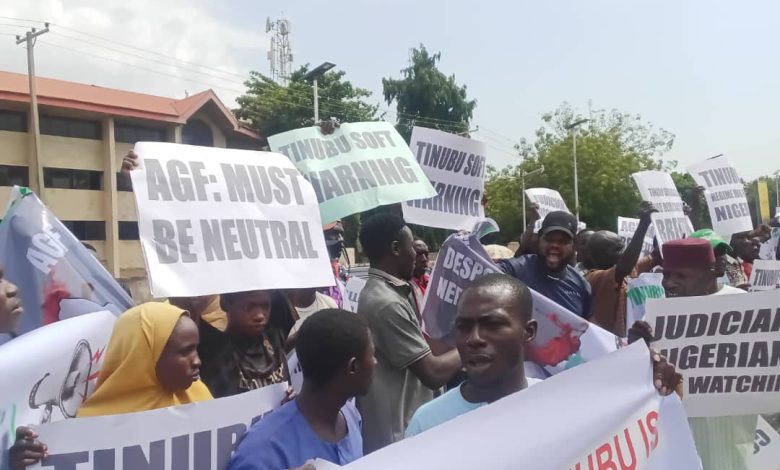
Operating under the banner of the Concerned Northern Nigeria Stakeholders, the demonstrators marched to the court complex in Abuja’s Wuse district, accusing the Federal Government of backing efforts that could strip several opposition parties of legal recognition — a development they argued would narrow Nigeria’s democratic space ahead of future electoral contests.
Placards bearing messages such as “No Opposition, No Election,” “Tinubu, Let Our Democracy Breathe,” and “AGF Must Be Neutral” reflected broader anxieties about the independence of state institutions, particularly the judiciary and the Independent National Electoral Commission.
Protesters target judiciary, presidency
Security was visibly tightened around the court complex, with armed personnel, including operatives of the Department of State Services, blocking access to the premises as protesters chanted and addressed journalists.
Speaking on behalf of the group, Banki Sharrif accused the government of exerting undue influence over democratic institutions, warning that any perception of judicial interference in politically sensitive cases could deepen public distrust in the legal system.
He urged President Bola Ahmed Tinubu to refrain from any direct or indirect involvement in judicial matters, arguing that courts must remain impartial arbiters rather than instruments of political strategy.
Sharrif also called on Attorney-General Lateef Fagbemi to preserve the neutrality of his office, insisting that the Ministry of Justice must not become entangled in partisan disputes.
The legal battle at the centre
At the heart of the controversy is an ongoing legal action seeking the deregistration of several opposition parties, including the African Democratic Congress, Action Peoples Party, Action Alliance, Accord Party, and Zenith Labour Party.
The suit, reportedly backed by former lawmakers and supported by the Attorney-General’s office, argues that the parties have failed to satisfy constitutional requirements necessary to retain registration.
What remains unclear, however, is whether the legal push is rooted strictly in electoral compliance standards or whether broader political calculations are shaping the case — a distinction likely to define public perception of the proceedings.
Why this matters beyond party politics
While smaller parties rarely command national dominance, they play an outsized role in Nigeria’s democratic structure. They often serve as coalition partners, regional political vehicles, or alternatives for dissatisfied voters outside the orbit of the dominant ruling and opposition blocs.
Any move perceived as selectively targeting opposition platforms could fuel allegations of democratic backsliding — particularly in a country where electoral credibility remains a sensitive national issue.
Nigeria’s Fourth Republic has repeatedly been tested by concerns over executive influence, institutional weakness, and shrinking civic trust. Against that backdrop, even legally defensible actions can generate political suspicion if transparency is lacking.
For ordinary Nigerians, the consequences are practical: fewer political choices, weaker electoral competition, and growing cynicism about whether institutions can act independently of power.
What happens next
The courts will now determine whether the affected parties have indeed fallen short of constitutional requirements or whether the suit lacks merit. That judgment could set an important precedent for how Nigeria regulates political parties moving forward.
But beyond the legal arguments, the bigger issue may be perception. Public confidence in democratic institutions depends not only on lawful decisions, but on decisions widely seen as fair, impartial, and free from political pressure.
What unfolds in court could therefore shape more than party registration — it may influence how Nigerians judge the health of their democracy itself.