










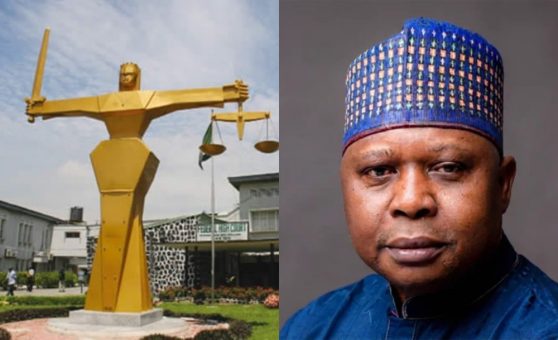
 A high-stakes legal battle over the leadership structure of the People’s Democratic Party reached a critical point on Friday as factional leader Tanimu Turaki arrived at the Supreme Court ahead of judgment in a case that could shape the party’s internal stability heading into the 2027 general elections.
The matter before the apex court, marked SC/CV/166/2026, seeks to overturn a Court of Appeal ruling that nullified a party exercise on grounds that it violated an existing court order. While the precise exercise at the centre of the dispute remains subject to judicial review, the broader implication is clear: the Supreme Court’s decision could determine which bloc gains legal footing in the PDP’s continuing leadership contest.
The judgment was scheduled for 2 p.m., alongside a separate appeal involving the African Democratic Congress, another opposition party now entangled in its own internal crisis.
Opposition parties under judicial scrutiny
The PDP’s appearance before the Supreme Court comes at a politically sensitive moment. Nigeria’s opposition landscape is increasingly defined not just by ideological competition with the ruling party, but by internal legal battles over leadership legitimacy, congresses, and party control.
In a related development, a Federal High Court on Wednesday restrained the Independent National Electoral Commission from recognising ADC congresses conducted under the leadership of David Mark pending the resolution of internal disputes within that party.
Taken together, both cases expose a deeper structural challenge confronting opposition politics in Nigeria: the inability of major parties to resolve internal conflicts quickly enough to focus on electoral mobilisation.
Why the ruling matters now
Timing is central to the significance of the Supreme Court proceedings.
INEC has already fixed May 10 as the deadline for political parties to submit updated membership registers — a foundational requirement for party organisation ahead of the elections. Party primaries and the settlement of nomination disputes are also scheduled to run between April 23 and May 30, 2026.
That leaves little room for prolonged litigation.
If leadership disputes persist beyond these timelines, affected parties could face organisational paralysis, delayed primaries, factional candidate lists, or legal challenges to nominations — all of which could weaken their competitiveness in 2027.
For party members and ordinary supporters, these disputes have practical consequences: uncertainty over recognised leadership often disrupts grassroots mobilisation, fundraising, and local party structures that are critical during campaign season.
Historical pattern of internal crises
Leadership disputes are hardly new to the PDP. Since losing presidential power in 2015, the party has repeatedly grappled with factional tensions, convention disputes, and competing claims to authority. While it has remained Nigeria’s largest opposition platform, internal instability has periodically undermined its ability to present a united electoral front.
The ADC’s current legal troubles suggest that smaller opposition coalitions may also be vulnerable to the same internal fault lines, even as they seek to expand national relevance.
What comes next
Attention is now on the Supreme Court’s ruling and how swiftly the PDP can consolidate around its outcome, whichever way the judgment goes. Political observers will also watch whether the ADC’s parallel legal dispute deepens uncertainty within opposition ranks.
With presidential and National Assembly elections set for January 16, 2027, and governorship and state assembly polls following on February 6, 2027, the electoral clock is already ticking.
The bigger test for Nigeria’s opposition may no longer be whether it can challenge incumbency — but whether it can first put its own house in order.