









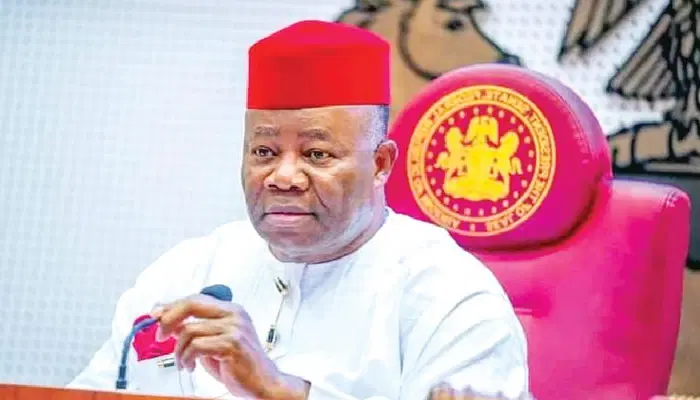
 The President of the Senate, Godswill Akpabio, has attributed the recent drawdown of United States embassy staff in Nigeria to broader geopolitical tensions involving Iran, rather than domestic political developments. His remarks come amid growing public concern over foreign diplomatic movements and their implications for Nigeria’s security climate.
Speaking on Tuesday at the inauguration of the National Assembly Service Commission’s new headquarters in Abuja, Akpabio said Washington’s decision reflects precautionary measures tied to fears of potential Iranian reprisals against American interests globally.
According to him, the United States is acting out of concern that its embassies, including those in Nigeria, could become targets if tensions with Iran escalate further.
“America is a bit worried about bomb blasts from Iran, and so across the world, they have to reduce their staff in case Iran decides to attack their embassies,” Akpabio said.
Not Nigeria-specific, Senate President insists
Akpabio stressed that the move is not unique to Nigeria, pushing back against speculation that it signals a deterioration in the country’s internal security or political stability ahead of future elections.
He argued that embassy staff reductions are part of a wider global security protocol adopted by countries facing threats from hostile states or non-state actors.
His comments also sought to calm anxieties over reports of diplomatic missions scaling back operations in Abuja. “The election will come and go,” he said, adding that Nigeria would remain stable despite heightened political activity.
What the US has said
The United States Department of State had earlier issued a security advisory to its citizens in Nigeria, warning of elevated risks in several parts of the country. The advisory included the evacuation of certain staff members from its embassy in Abuja, while the consulate in Lagos continues operations.
In addition, Washington identified 23 Nigerian states as high-risk zones, advising its citizens to avoid non-essential travel to those areas. While the advisory did not explicitly cite Iran, it referenced broader security concerns, including terrorism, kidnapping, and armed criminality.
Background: Global tensions, local anxieties
Tensions between the United States and Iran have persisted for years, often manifesting in proxy conflicts and sporadic escalations across different regions. In such contexts, US diplomatic missions worldwide routinely adjust staffing levels based on intelligence assessments.
Nigeria, while geographically distant from the Middle East conflict, has in recent years faced its own security challenges — from insurgency in the North-East to banditry and kidnapping in the North-West and North-Central regions. These overlapping threats often shape how foreign governments assess risk within the country.
Impact on Nigerians
For many Nigerians, the reduction in embassy staff — even if precautionary — carries symbolic weight. It can influence investor confidence, diplomatic engagement, and public perception of safety, particularly in Abuja, the nation’s administrative hub.
There are also practical implications. Reduced embassy staffing can slow visa processing, limit consular services, and affect Nigerians seeking travel, education, or business opportunities in the United States.
What remains unclear
While Akpabio has linked the decision to fears of Iranian action, US officials have not publicly confirmed this specific rationale. It remains unclear how much of the staff reduction is tied to global geopolitical risks versus Nigeria’s internal security concerns.
What to watch
Attention will likely shift to whether other foreign missions adopt similar measures and how Nigerian authorities respond to reassure both citizens and international partners.
For now, the federal government faces a delicate task: addressing legitimate security concerns without amplifying perceptions that could further unsettle public confidence or diplomatic relations.