









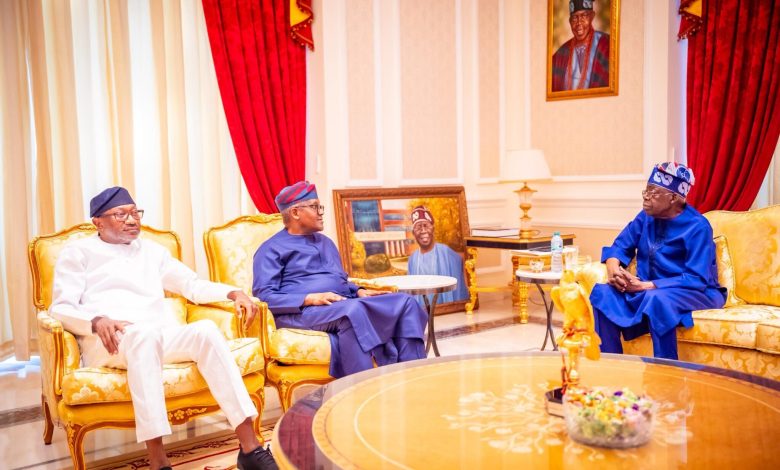
 President Bola Ahmed Tinubu spent Easter Sunday in closed-door talks with two of Nigeria’s most influential businessmen—Femi Otedola and Aliko Dangote—in what aides describe as part of an ongoing effort to align government reforms with private sector expectations.
The meeting, held at the President’s Ikoyi residence in Lagos, comes at a time when Nigerians are grappling with the immediate effects of sweeping economic changes, including subsidy removal, currency adjustments, and rising cost of living.
Otedola confirmed the visit publicly on Monday via his X (formerly Twitter) account, stating that discussions focused on “how Nigerians can benefit from the reforms.” He also highlighted Tinubu’s work ethic, noting that the President remained engaged in policy conversations even on a major holiday.
Private Capital Meets Public Policy
While details of the discussions were not formally disclosed by the presidency, the optics are significant. Dangote, whose business empire spans cement, sugar, and oil refining, and Otedola, a key figure in energy and finance, represent sectors deeply affected by government policy shifts.
Their presence signals continued consultation between the Tinubu administration and large-scale investors whose decisions can influence prices, employment, and foreign investment flows. In practical terms, such engagements often precede adjustments in implementation—whether in taxation, energy pricing, or industrial policy.
Also present in the President’s orbit over the holiday was Abdul Samad Rabiu, who separately told State House correspondents that his visit was primarily to extend Eid-el-Fitr greetings and belated birthday wishes to Tinubu, who turned 74 on March 29.
Why This Matters Now
The timing of the meeting is as important as the participants. Nearly a year into Tinubu’s reform agenda, public patience is being tested. Inflation remains elevated, the naira has experienced volatility, and households continue to feel pressure from higher transport and food costs.
For many Nigerians, the critical question is no longer whether reforms are necessary, but when—and how—their benefits will materialise.
Engagements like this suggest the administration is seeking buy-in from the private sector to stabilise supply chains, boost domestic production, and potentially moderate price shocks. However, such high-level consultations also raise questions about inclusivity—particularly whether small businesses and informal sector operators, who employ a majority of Nigerians, have a voice in shaping outcomes.
Background: Reform Agenda and Its Fallout
Since taking office in May 2023, Tinubu has pursued a market-oriented reform programme aimed at correcting long-standing fiscal imbalances. The removal of petrol subsidies and the unification of foreign exchange rates were among the earliest and most consequential decisions.
While these measures have been praised by international financial institutions and investors as necessary corrections, they have also triggered short-term hardship. Labour unions have staged protests, and the government has introduced palliative measures—cash transfers and food distribution—to cushion the impact, with mixed results.
What Comes Next
It remains unclear whether Sunday’s discussions will translate into specific policy shifts or new interventions. No official communiqué has been issued outlining concrete outcomes.
However, analysts say continued dialogue between government and major investors could influence decisions around energy pricing, local refining capacity, and investment incentives—areas that directly affect everyday costs.
For citizens, the immediate concern is tangible relief. If these engagements lead to increased production, improved supply, or moderated prices, the benefits could become visible in the coming months. If not, public scrutiny of both government and big business is likely to intensify.
For now, the meeting underscores a central tension in Nigeria’s economic transition: balancing long-term reform with short-term survival.