









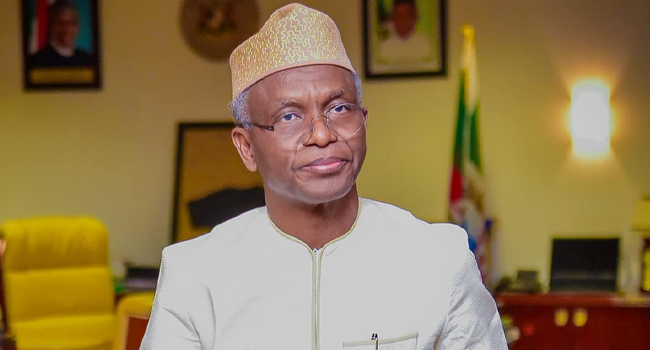
 A fresh legal dispute involving former Kaduna State governor Nasir El-Rufai is drawing attention to longstanding concerns about judicial impartiality in Nigeria, after he formally asked the country’s top judicial officer to intervene in his ongoing court case.
In a petition dated April 9, 2026, El-Rufai urged the Chief Justice of Nigeria, Kudirat Kekere-Ekun, to reassign his case away from Justice R. M. Aikawa of the Federal High Court in Kaduna, citing what he described as an “unavoidable perception of bias.”
Allegations of bias and procedural concerns
According to the petition, El-Rufai questioned the propriety of Justice Aikawa continuing to preside over the matter, arguing that the judge’s involvement does not meet expected standards of judicial neutrality and ethical conduct.
He pointed to multiple petitions already filed against the judge, which are currently before the Chief Judge of the Federal High Court and the National Judicial Council (NJC), Nigeria’s body responsible for disciplining judicial officers.
The former governor argued that the overlap between his current case and earlier proceedings involving similar parties and issues raises legitimate concerns about fairness. In his view, continuing under the same judge risks eroding confidence in the process.
“El-Rufai warned that proceeding in this manner could ultimately undermine the credibility of the judiciary,” the petition stated, adding that any resulting judgment might be vulnerable to being overturned on appeal.
Why this matters beyond one case
While the dispute is formally about case reassignment, it touches on a deeper institutional issue: public trust in Nigeria’s courts. Allegations of judicial bias — whether proven or not — have historically weakened confidence in legal outcomes, particularly in politically exposed cases.
El-Rufai’s intervention is significant because it places the Chief Justice in a delicate position: balancing the independence of trial judges with the need to uphold the appearance, as well as the reality, of fairness.
Legal analysts note that even the perception of bias can be as damaging as actual misconduct, especially in high-profile cases where public scrutiny is intense.
Background: recurring debates over judicial independence
Nigeria’s judiciary has faced periodic criticism over case assignments, delays, and allegations of external influence. The National Judicial Council has, in recent years, disciplined several judges for ethical breaches, but concerns persist about transparency in how sensitive cases are handled.
Requests for case reassignment are not unprecedented, but they are typically granted only when there is clear evidence that continuing with the same judge could compromise fairness or public confidence.
In politically sensitive matters, such decisions often carry wider implications, shaping how the judiciary is perceived both domestically and internationally.
What is known — and what is not
It is confirmed that El-Rufai has formally petitioned the Chief Justice seeking reassignment of his case and raising concerns about Justice Aikawa’s conduct.
However, the specific details of the underlying case, the exact nature of the alleged bias, and the content of the petitions already before the NJC have not been made public.
As of the time of reporting, neither the office of the Chief Justice nor the National Judicial Council has issued an official response.
Possible next steps
The Chief Justice may choose to review the petition administratively or refer aspects of it to the NJC for further investigation. If the concerns are deemed substantial, the case could be reassigned to another judge either within Kaduna or in a different jurisdiction.
For ordinary Nigerians, the outcome will be closely watched as a test of how responsive the judicial system is to concerns about fairness — particularly in cases involving powerful political figures.
Beyond the immediate parties, the decision could set a precedent for how similar petitions are handled in the future, and whether institutional safeguards are strong enough to maintain trust in the courts.