










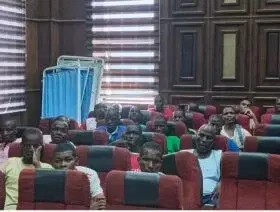
 The Federal High Court in Abuja on Tuesday began hearing a fresh round of terrorism cases involving dozens of suspects, in a rare relocation of proceedings that underscores both the scale of Nigeria’s security crisis and the strain on its judicial system.
Ordinarily held in Kainji—a location chosen for its relative isolation and proximity to high-security detention facilities—the trials were moved to Abuja to accommodate the court’s annual Easter vacation schedule. The shift has effectively transformed the capital’s court complex into a temporary hub for high-risk prosecutions, with all 13 courtrooms assigned to terrorism-related cases.
A Court Under Lockdown
Security around the court premises was visibly tightened. Armed personnel cordoned off access roads within the Central Business District, while police helicopters conducted aerial surveillance. The scale of the operation reflects longstanding concerns about the risks associated with transporting and trying suspected members of insurgent groups, particularly in urban centres.
Legal proceedings began before multiple judges, including Binta Nyako, Emeka Nwite, Musa Liman, and Akpan Ekerete. In one of the lead cases, the Director of Public Prosecutions of the Federation, Rotimi Oyedepo, SAN, led the federal government’s legal team, while Aliyu Abubakar, head of the Legal Aid Council, represented at least 20 defendants.
Names listed in early proceedings include Hamat Modu, Isah Ali, Awal Bello, Shehu Bukar, Alhaji Kulle, Mohammed Abacha Hassan, Aminami Mallum, Tasiu Yakubu, and Abdullahi Ali. Authorities have not publicly detailed the specific charges against each individual, but all are facing terrorism-related allegations.
Why the Trials Matter Now
The timing and scale of these proceedings are significant. Nigeria has, for over a decade, grappled with insurgencies linked to groups such as Boko Haram and its offshoot, Islamic State West Africa Province. Mass trials have become a central strategy for clearing a backlog of cases involving suspects detained during military operations, particularly in the North-East.
However, the relocation to Abuja introduces a new dynamic. Unlike Kainji, which is relatively removed from public scrutiny, proceedings in the capital bring the trials closer to Nigeria’s political and media centres. This could increase transparency—but also heightens security risks.
For ordinary Nigerians, the trials are a reminder of the long tail of the insurgency. Thousands of detainees have spent years in custody awaiting trial, raising concerns from human rights groups about due process, prolonged detention, and the adequacy of legal representation.
Legal and Human Rights Questions
While the government has framed the mass trials as a step toward accountability, critics have previously questioned whether the compressed format allows for thorough examination of evidence. The presence of the Legal Aid Council suggests an effort to ensure representation, but it remains unclear how much time each case will receive in court.
What is known is that multiple defendants are being processed simultaneously across different courtrooms. What is not yet clear is how many total suspects will be tried during this session, how long the proceedings will last, or whether convictions—if secured—will withstand appellate scrutiny.
Background: From Kainji to Abuja
Mass terrorism trials in Nigeria gained prominence in 2017, when the federal government began prosecuting hundreds of suspects in phases at Kainji. The approach was designed to fast-track justice while easing pressure on detention facilities.
Over time, however, logistical challenges—including transporting suspects, coordinating legal teams, and ensuring security—have complicated the process. The temporary move to Abuja reflects both administrative necessity and the evolving nature of the trials.
What Comes Next
The court’s Easter vacation is scheduled to run until April 13, with full judicial activities expected to resume nationwide on April 14. It remains to be seen whether the terrorism trials will continue in Abuja beyond that date or revert to Kainji.
In the immediate term, attention will focus on how efficiently the courts can handle the volume of cases and whether proceedings meet standards of fairness and transparency. Longer term, the outcome of these trials could shape public confidence in Nigeria’s justice system—and its ability to respond to one of the country’s most persistent security challenges.
For residents of Abuja, the heightened security presence may be temporary. For the country, the deeper question is whether these trials mark real progress toward justice, or simply another chapter in a prolonged and complex conflict.