









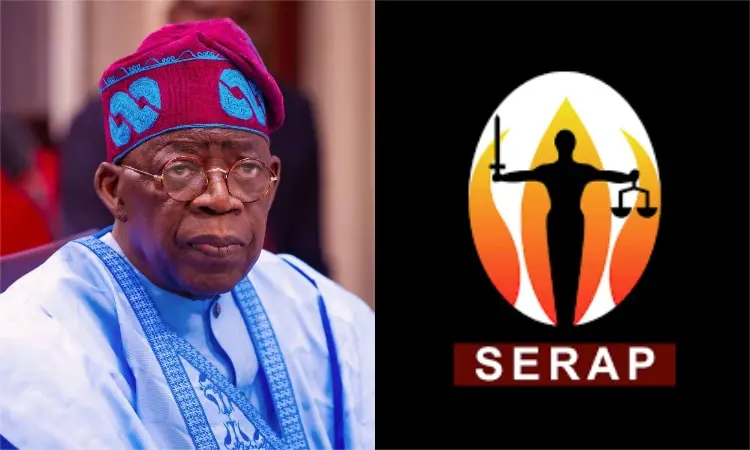
 Nigeria’s persistent struggle with public sector accountability has come under renewed scrutiny after the Socio-Economic Rights and Accountability Project (SERAP) called on President Bola Ahmed Tinubu to investigate alleged financial irregularities totalling N2.9 billion across two sensitive government agencies.
In a letter dated April 11, 2026, and signed by its Deputy Director, Kolawole Oluwadare, SERAP urged the President to direct a comprehensive probe into transactions involving the Nigerian Communications Satellite Ltd and the Nigerian Nuclear Regulatory Authority. The group also called for the involvement of the Attorney-General of the Federation, Lateef Fagbemi, and anti-corruption agencies to ensure accountability and prosecution where necessary.
Allegations rooted in Auditor-General’s findings
SERAP said its demands are based on findings from the Auditor-General’s report published on September 9, 2025, which detailed a series of questionable financial transactions and procedural breaches within the two agencies.
At NIGCOMSAT, the report flagged an “unauthorised investment” of N465 million in a private firm, Gicell Wireless Ltd, without evidence of due approval or proper investment appraisal. The company, with an authorised share capital of just one million ordinary shares, reportedly received the funds in exchange for 200,000 shares — a valuation that raises questions about due diligence and oversight.
Additional concerns include over N507.9 million in internally generated revenue allegedly not remitted to the Consolidated Revenue Fund, alongside N1.68 billion in unrecovered debts. The report also cited smaller but recurrent irregularities: undocumented staff reimbursements, rent discrepancies, and expenditures on branding and marketing carried out without procurement approval.
At the NNRA, the Auditor-General identified multiple payments lacking documentation or proof of execution. These include N33.4 million reportedly paid for items not supplied, N4.35 million for training without evidence it occurred, and N2.05 million spent on foreign training in Dubai without confirmation of attendance. Other flagged transactions involve unretired advances and unrecorded penalty revenues.
In several instances, the report warned that funds “may have been diverted or lost,” though it stopped short of making definitive conclusions on criminal liability.
Why this matters now
The agencies involved occupy critical positions in Nigeria’s national infrastructure. NIGCOMSAT plays a central role in satellite communications and digital connectivity, while the NNRA is responsible for nuclear safety and regulatory oversight — a sector where lapses could carry far-reaching consequences.
For ordinary Nigerians, these allegations reinforce long-standing concerns about how public funds are managed, particularly in technical sectors that receive less public scrutiny. At a time when the government is pushing digital transformation and economic reforms, financial opacity within such institutions risks undermining both investor confidence and public trust.
Pressure mounts on government response
SERAP has given the federal government a seven-day ultimatum to act, warning that failure to initiate an investigation could lead to legal action. The organisation is also demanding that NIGCOMSAT disclose the ownership structure of the company that received the N465 million investment, raising transparency concerns about possible conflicts of interest.
The group described the allegations as a “grave violation of public trust” and a breach of Nigeria’s anti-corruption obligations, stressing that accountability must extend beyond internal queries to include prosecution where wrongdoing is established.
What is known — and what is not
While the Auditor-General’s report documents extensive financial irregularities, it does not conclusively establish intent or confirm that funds were definitively stolen. No official response has yet been issued by NIGCOMSAT or NNRA addressing the specific allegations.
Similarly, it remains unclear whether any internal disciplinary measures or preliminary investigations have been initiated within the agencies since the report’s publication.
A familiar pattern in Nigeria’s audit cycle
Nigeria’s Auditor-General reports have historically revealed significant lapses in financial management across ministries, departments, and agencies, but follow-through actions — including prosecutions and fund recovery — have often been inconsistent.
This gap between audit findings and enforcement has contributed to a cycle where infractions are documented but rarely resolved, weakening the deterrent effect of oversight institutions.
What to watch next
Attention will now turn to whether the Tinubu administration acts within the timeframe set by SERAP and, more importantly, whether any investigation leads to concrete outcomes — including recovery of funds and sanctions against those found culpable.
For a government that has repeatedly pledged to strengthen transparency and fiscal discipline, the handling of this case may serve as a litmus test. Failure to act decisively could deepen public scepticism, while a credible probe could signal a shift toward stronger institutional accountability.