









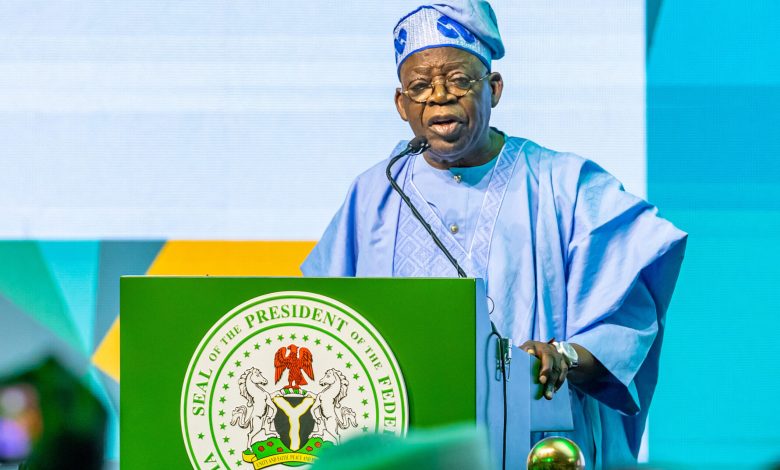
 President Bola Ahmed Tinubu has reiterated his administration’s focus on Nigeria’s most pressing challenges, promising fresh efforts to address economic hardship, chronic electricity shortages, and persistent insecurity.
Speaking in Yenagoa, Bayelsa State, the President said his government would continue to prioritise policies aimed at easing the burden on low-income Nigerians, even as economic reforms continue to reshape the country’s fiscal landscape.
“We won’t stop moving forward, and we’ll keep looking for ways to help those who are struggling,” Tinubu said, framing his administration as one committed to social support amid ongoing economic strain.
Power sector at the centre of growth agenda
Tinubu placed particular emphasis on electricity supply, describing it as the backbone of industrial development and human capital growth. Without stable power, he argued, efforts to expand manufacturing, create jobs, and build technical skills would remain constrained.
“You can’t have industrial growth, learning new skills, or people gaining strength without having enough power,” he said, adding a renewed promise to improve electricity access nationwide.
The remarks come as businesses and households continue to grapple with erratic supply and rising energy costs, forcing many to rely on expensive alternatives such as diesel and petrol generators — a major contributor to the high cost of production and living.
Security assurances amid lingering threats
On national security, the President pledged to strengthen the operational capacity of Nigeria’s armed forces to confront terrorism and banditry. While he did not outline specific new measures, he assured that the government would continue to invest in equipping security agencies.
“We will defeat terrorism and banditry,” Tinubu said.
His comments reflect ongoing federal efforts to stabilise regions affected by insurgency in the North-East and banditry in parts of the North-West and North-Central — conflicts that have displaced communities, disrupted farming, and contributed to food inflation.
Political undertones in Bayelsa visit
Tinubu also used the occasion to commend Bayelsa State Governor Douye Diri, praising his leadership style and governance approach. While largely ceremonial, such endorsements often carry political weight in a region where federal-state relations can shape development outcomes and electoral alignments.
Why this matters now
The President’s remarks come at a time when many Nigerians are facing rising living costs, driven in part by fuel subsidy removal, currency pressures, and inflation. For ordinary citizens, the promises of economic relief and improved infrastructure are closely tied to daily realities — from transport fares to food prices and access to reliable power.
However, beyond broad assurances, there remains limited clarity on the timeline and scope of new interventions. Key questions — including how quickly power reforms can deliver stable electricity, and whether security improvements will translate into safer rural communities — remain unanswered.
Background: Reform and public pressure
Since taking office in 2023, Tinubu’s administration has pursued sweeping economic reforms aimed at stabilising public finances and attracting investment. These include subsidy removal and exchange rate adjustments, policies widely seen by economists as necessary but socially disruptive in the short term.
Public pressure has mounted for targeted relief measures, as wage growth struggles to keep pace with inflation and unemployment concerns persist.
What to watch next
Attention will likely shift to policy execution — particularly in the power sector, where previous administrations have made similar commitments with mixed results. The effectiveness of security spending and coordination among agencies will also be closely scrutinised.
For now, the President’s statements signal continuity in policy direction, but Nigerians will be watching for tangible improvements in electricity supply, security conditions, and the cost of living in the months ahead.