










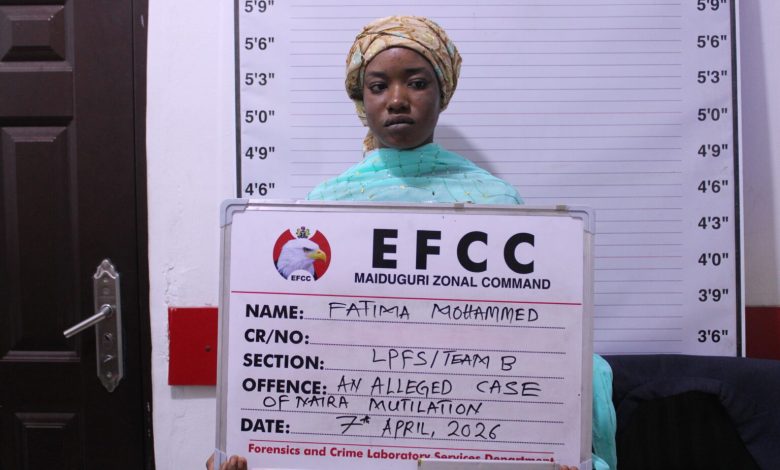
 The Economic and Financial Crimes Commission (EFCC) has arrested a woman in Maiduguri, Borno State, over what it describes as the mutilation of the naira—an offence that has increasingly drawn enforcement attention amid Nigeria’s fragile currency climate.
In a statement issued by its Maiduguri Zonal Directorate, the agency said Fatima Muhammed was taken into custody on Tuesday, April 7, 2025, after a video circulated on TikTok showed her using a ₦500 note to wipe mucus from her nose. EFCC operatives reportedly tracked and apprehended her within the Maiduguri metropolis shortly after the video gained traction online.
The Commission said the suspect remains in detention while investigations continue, adding that she will be charged to court upon conclusion of the probe.
What the Law Says About Naira Abuse
Under Nigerian law, specifically provisions of the Central Bank of Nigeria (CBN) Act, the defacing, mutilation, or improper handling of the naira is a punishable offence. This includes spraying, tearing, writing on, or otherwise damaging currency notes.
While enforcement has historically been uneven, authorities have in recent years stepped up public messaging and selective prosecutions. The EFCC and the CBN have both warned that abuse of the naira undermines public confidence in the currency and contributes to its deterioration in circulation.
A Shift in Enforcement Strategy?
The Maiduguri arrest reflects a growing pattern: viral social media content triggering real-world law enforcement action. In this case, the EFCC acted after the video spread widely, suggesting that digital visibility is becoming a key factor in prioritising such cases.
However, the development raises questions about proportionality and consistency. Critics have long argued that enforcement tends to focus on symbolic or low-level infractions—often involving ordinary citizens—while more systemic financial crimes remain harder to prosecute.
For residents in Maiduguri and elsewhere, the case underscores how everyday behaviour—particularly when shared online—can attract legal consequences. It also highlights the expanding reach of surveillance-by-virality, where public scrutiny effectively deputises citizens into enforcement ecosystems.
Broader Economic Context
Nigeria’s currency has been under sustained pressure, with inflation eroding purchasing power and cash scarcity episodes—most notably during the 2023 naira redesign—exposing structural weaknesses in cash management.
In that context, authorities have framed naira protection as both a legal and economic necessity. The argument is that preserving the physical integrity of notes reduces replacement costs and supports monetary stability, though economists note that macroeconomic factors such as inflation, exchange rates, and fiscal policy play a far larger role.
What Happens Next
The EFCC has not disclosed the specific charges Fatima Muhammed will face, but naira mutilation offences can attract fines, imprisonment, or both, depending on severity and judicial discretion.
What remains unclear is whether this case will proceed as a straightforward prosecution or serve primarily as a deterrent example. The EFCC has not indicated whether others featured in similar viral content are under investigation.
Why This Story Matters
Beyond the unusual nature of the allegation, the case speaks to a wider tension in Nigeria’s law enforcement priorities: balancing symbolic offences with more complex economic crimes. It also reflects how social media is reshaping accountability—sometimes blurring the line between public interest enforcement and selective visibility.
As the EFCC moves to file charges, attention will likely shift to the courts, where the interpretation of “mutilation” and the proportionality of punishment could set a tone for future cases. For now, the message from authorities is clear: the naira, even in everyday use, is not to be treated casually—and the internet is watching.