










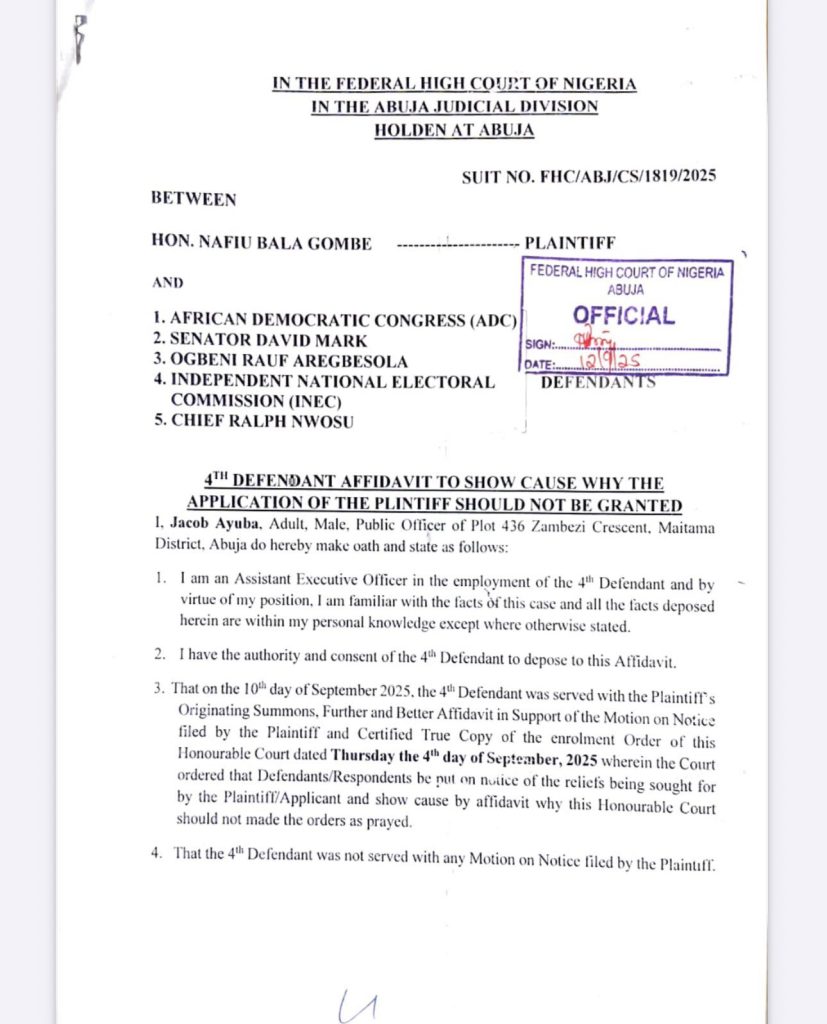
 The African Democratic Congress (ADC) has escalated an ongoing dispute over its leadership structure by publishing what it describes as an official affidavit from the Independent National Electoral Commission (INEC), affirming that the party’s National Working Committee (NWC) under former Senate President David Mark had already been duly recognised as far back as September 12, 2025.
The document, released on Tuesday, is central to the party’s effort to close ranks internally while pushing back against what it perceives as external interference. According to ADC officials, the affidavit explicitly confirms that the leadership transition had been concluded before that date and was acknowledged by INEC as an internal party matter.
What the Affidavit Says
ADC pointed to Clauses 14 to 19 of the affidavit as the most critical sections, arguing that they clearly establish two key positions: first, that the leadership process was finalised within the party’s constitutional framework; and second, that such matters fall outside the remit of judicial intervention.
While the full legal interpretation of the affidavit has not yet been independently verified in court, the party insists it strengthens the long-standing principle that political parties in Nigeria retain autonomy over their internal affairs—provided due process is followed.
Political Undercurrents and Allegations
Beyond the legal argument, the ADC’s statement took a sharply political turn. The party accused the administration of President Bola Ahmed Tinubu and the leadership of Independent National Electoral Commission of attempting to manipulate democratic institutions.
It specifically alleged that the electoral body, under its current chairman, is being used to tilt the political landscape towards a one-party system—an accusation that has become increasingly common among opposition parties in recent months.
These claims remain unproven, and neither the presidency nor INEC had issued an official response as of press time.
Why This Matters Now
The timing of the disclosure is significant. Nigeria’s political parties are already repositioning ahead of future electoral cycles, and internal cohesion is critical for smaller parties like the ADC seeking to expand their national relevance.
Disputes over party leadership are not new in Nigeria, but they often spill into the courts and, in some cases, fracture party structures ahead of elections. By foregrounding an INEC-backed document, the ADC appears to be attempting to pre-empt further legal or administrative challenges to its leadership.
For ordinary Nigerians, the implications go beyond party politics. Confidence in INEC’s neutrality is a cornerstone of electoral credibility. Any perception—whether substantiated or not—that the commission is taking sides in intra-party disputes risks eroding public trust in the broader electoral process.
Historical Context: INEC and Party Autonomy
Nigeria’s electoral framework has long walked a fine line between regulation and autonomy. While INEC is empowered to oversee party registration and ensure compliance with electoral laws, courts have repeatedly held that internal party matters—such as leadership selection—should largely remain within party structures.
However, this boundary has often been tested. From the crises in major parties like the PDP and APC to smaller parties struggling with factionalism, INEC’s role has sometimes drawn scrutiny, particularly when its recognition of one faction over another carries political consequences.
What Happens Next
The ADC’s move is unlikely to end the matter. If rival factions exist within the party, the dispute could still find its way back into the courts despite the affidavit’s claims. Legal experts note that while parties have autonomy, courts can intervene where there are allegations of procedural breaches or violations of party constitutions.
Meanwhile, attention will shift to how INEC responds—if at all—to the public release of the affidavit and the accompanying allegations. Silence could fuel further speculation, while a formal clarification might help stabilise perceptions.
For now, the ADC has drawn a line, asserting both legal backing and political resistance. Whether that position holds will depend not only on documents already signed, but on how Nigeria’s institutions navigate the increasingly contested space between party politics and public accountability.