









 A quiet decision by a Nigerian woman to end her marriage has triggered a wider conversation about responsibility, endurance, and the limits of patience within family life — issues that resonate far beyond the viral post that brought her story into public view.
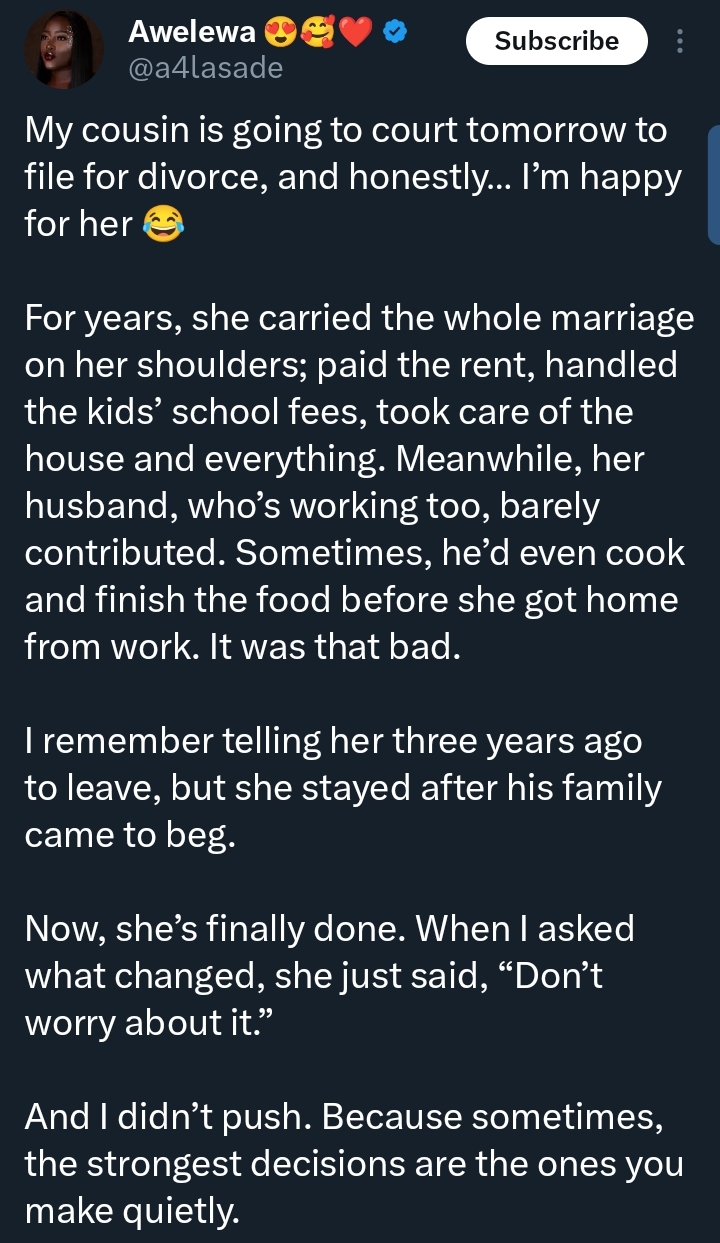
The case surfaced after a relative shared online that her cousin would be heading to court to file for divorce, describing the move as “long overdue.” While the post itself was brief, the details that followed painted a picture of a marriage many Nigerians would recognise: one sustained largely by one partner, with emotional and financial strain building over time.
A Marriage Carried by One
According to the account, the woman had for years borne the bulk of both financial and domestic responsibilities. She reportedly paid rent, covered children’s school fees, and managed the household — despite her husband being employed.
More troubling, the cousin alleged patterns of neglect that went beyond finances, including instances where the husband cooked for himself without making provisions for his wife. These details, while not independently verified, shaped public perception of a relationship marked by imbalance rather than partnership.
Family members had previously intervened about three years ago, urging reconciliation when the woman first considered leaving. Such interventions are common in Nigeria, where extended families often play a decisive role in marital disputes. In this case, however, the intervention appears to have prolonged, rather than resolved, the underlying issues.
The woman’s eventual decision to proceed with divorce came without public explanation. When asked what prompted her final step, she reportedly replied, “Don’t worry about it,” suggesting a deeply personal tipping point.
Cultural Expectations and Quiet Pressures
Divorce remains a sensitive subject in many parts of Nigeria, where cultural, religious, and social expectations often prioritise endurance over separation. Women, in particular, face pressure to maintain marriages despite hardship, especially when children are involved.
Legal provisions exist under statutes such as the Matrimonial Causes Act, allowing for dissolution of marriage on grounds including irretrievable breakdown. Yet in practice, social stigma and financial uncertainty often discourage couples — especially women — from pursuing formal separation.
Stories like this one highlight a growing tension between traditional expectations and shifting attitudes, particularly among younger Nigerians who increasingly prioritise mental health, personal dignity, and economic fairness within relationships.
Social Media Reaction: Sympathy and Skepticism
The online response to the story has been sharply divided, reflecting broader societal debates.
Some users framed the decision as an act of self-preservation. One commenter, identified as Dammy Esquire, argued that “peace of mind matters,” suggesting that the woman’s choice represented strength after years of imbalance.
Others, however, questioned both the decision and the public celebration of it. A user named Adedoyin criticised the cousin’s reaction, arguing that family members should encourage reconciliation, especially in marriages involving children. Another commenter raised questions about whether efforts had been made to understand the husband’s behaviour.
A third group focused less on the divorce itself and more on the dynamics described, questioning how such an arrangement persisted for years and what it says about expectations within marriage.
What This Means for Families
Beyond the online debate, the situation underscores a practical reality: when one partner shoulders disproportionate responsibility over time, the strain can have consequences not just for the couple but for children and extended family structures.
If the divorce proceeds, the next steps would likely involve legal processes around custody, financial support, and asset division — areas that can be complex and, in some cases, contentious. For many Nigerian women, these proceedings also carry economic risks, particularly where informal financial arrangements dominated the marriage.
What Is Known — and What Is Not
At this stage, the account remains based on a relative’s narration shared online. There has been no public statement from the woman or her husband, and the full circumstances of the marriage — including the husband’s perspective — are not known.
What is clear, however, is that the story has struck a nerve. It touches on questions many families quietly confront: How much should one endure in a marriage? At what point does persistence become self-sacrifice? And who gets to decide when enough is enough?
Looking Ahead
As conversations about marriage evolve in Nigeria, cases like this are likely to become more visible — and more contested. Whether viewed as a necessary assertion of self-worth or a troubling sign of weakening family bonds, the decision to walk away from a long-strained marriage continues to challenge deeply held assumptions.
For now, attention will shift to the courtroom, where a personal decision will enter a formal legal process — and where the private realities behind a viral story may, at last, come into clearer view.