









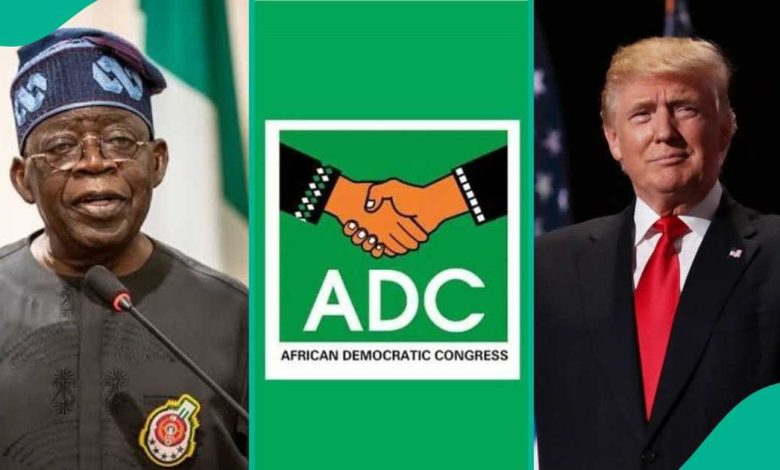
 Nigeria’s already tense pre-election climate has taken an unusual international turn, with a U.S.-based policy firm announcing plans to brief American political actors on the country’s electoral developments—specifically the Independent National Electoral Commission’s (INEC) decision to suspend recognition of the African Democratic Congress (ADC) leadership.
The firm, Von Batten-Montague York L.C., said in a statement on Friday that it would engage members of the United States Congress and former U.S. President Donald Trump over what it described as a troubling intervention in Nigeria’s opposition landscape. The move introduces a new layer of external scrutiny at a time when domestic confidence in electoral institutions is already under pressure.
INEC’s Decision and Its Immediate Impact
INEC recently halted all official dealings with the ADC, citing unresolved litigation over the party’s leadership. The commission said its position would stand pending the outcome of court proceedings—a stance that effectively sidelines the party from formal electoral activities for now.
While INEC has framed the move as procedural and grounded in the rule of law, its practical effect is political. The ADC, though not among Nigeria’s dominant parties, is widely seen as part of the broader opposition ecosystem expected to shape the next presidential contest.
By freezing its leadership structure, the commission has limited the party’s ability to organise, mobilise, or engage with the electoral process at a critical preparatory stage.
External Interest—and Why It Matters
In its statement, Von Batten-Montague York L.C. warned that the suspension could weaken political competition and undermine public trust in the electoral process.
“At a time when Nigerians expect free, fair, and credible elections, any development that disrupts political participation… must be addressed with urgency and transparency,” the firm said.
It also pointed to Nigeria’s strategic role in West Africa, arguing that electoral credibility in the country carries implications beyond its borders, including for regional security and economic stability.
The firm’s decision to escalate the issue to Washington is notable. While international observation of Nigerian elections is routine, direct lobbying of foreign political actors—particularly in the context of internal party disputes—is less common and raises questions about the growing internationalisation of Nigeria’s domestic politics.
What Is Known—and What Remains Unclear
INEC has not publicly indicated any political motive behind its decision, maintaining that the matter is tied strictly to ongoing legal disputes within the ADC. Details of those court cases, including timelines for resolution, remain limited in the public domain.
It is also unclear how much influence, if any, the U.S. policy firm’s engagement will have on official American policy. The reference to Donald Trump, who is not currently in office, suggests the effort may be as much about political signalling as it is about formal diplomatic pressure.
No response had been issued by the Nigerian presidency as of the time of reporting.
Historical Context: Electoral Trust Under Strain
Nigeria’s electoral system has faced recurring scrutiny, both domestically and internationally. Disputes over party leadership, candidate eligibility, and INEC’s administrative decisions have, in past election cycles, ended up in prolonged court battles—sometimes reshaping the ballot at late stages.
The 2023 general elections, while completed without major nationwide disruption, were followed by legal challenges and debates over transparency, particularly regarding result transmission. That backdrop has heightened sensitivity to any action perceived to limit political participation.
Implications for Ordinary Nigerians
For voters, the immediate effect of the ADC’s suspension may appear limited. However, the broader concern is about choice and confidence. If opposition parties are weakened—whether by internal crises or regulatory decisions—the range of viable political options narrows.
This, in turn, can affect voter turnout and trust. In a country where many citizens already question whether their votes translate into outcomes, perceptions of imbalance in the political field can deepen disengagement.
For smaller parties especially, administrative setbacks at this stage of the electoral cycle can be difficult to recover from, potentially consolidating power among a few dominant platforms.
What Comes Next
The trajectory of the ADC’s participation now hinges on the courts. A swift resolution could restore the party’s standing; a prolonged dispute may effectively exclude it from meaningful involvement in the next election cycle.
Meanwhile, the involvement of an external policy firm introduces the possibility of increased international commentary—or pressure—on Nigeria’s electoral process. Whether this translates into concrete diplomatic action remains uncertain.
For the Tinubu administration and INEC, the challenge will be to manage both the legal complexities and the perception of fairness. As election preparations intensify, scrutiny—both at home and abroad—is likely to grow.
What to watch in the coming weeks will be the pace of judicial proceedings, INEC’s subsequent actions, and whether other political actors—domestic or international—begin to weigh in on what is, at its core, a test of Nigeria’s electoral resilience.