










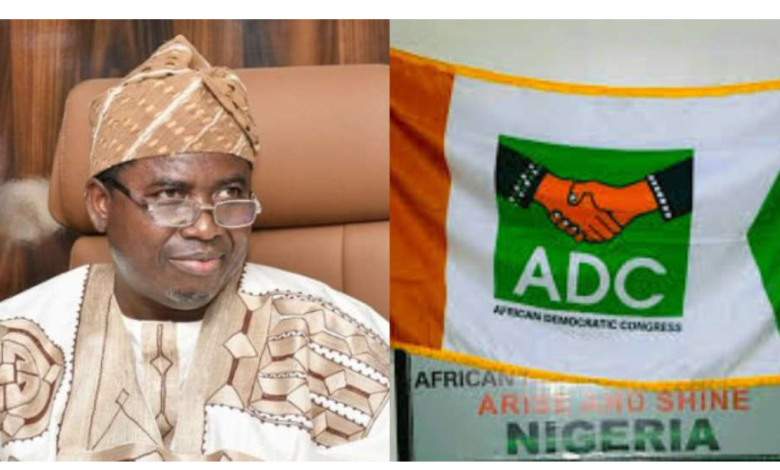
A simmering leadership dispute within the African Democratic Congress (ADC) escalated on Thursday, with the party accusing the Independent National Electoral Commission (INEC) of acting unlawfully and worsening internal divisions through what it describes as selective recognition of party actors.
The allegation, made by ADC National Publicity Secretary Bolaji Abdullahi during an appearance on Arise Television’s Morning Show, marks one of the sharpest public confrontations between a registered political party and Nigeria’s electoral umpire in recent months. At stake is not only control of the party’s structure but also the credibility of institutional neutrality ahead of future electoral cycles.
Dispute Over Authority
Abdullahi argued that a former party official, Nafiu Bala Gombe, no longer holds any legal standing to act on behalf of the party, citing his resignation and the subsequent dissolution of the executive committee to which he belonged.
“As at July 17, he was no longer an official of the party, and INEC knew this,” Abdullahi said. “So on what basis is INEC recognising his actions?”
He maintained that the ADC’s National Executive Committee (NEC)—the highest decision-making body after the national convention—had already taken binding decisions on the party’s leadership, and that such resolutions should be respected by all institutions, including INEC.
Allegations of Institutional Bias
The ADC spokesman accused INEC of taking sides in what should be an internal party matter. According to him, the commission’s continued acknowledgment of actions linked to Bala, despite formal notice of his resignation, amounts to interference.
More pointedly, Abdullahi alleged that INEC had disregarded a directive of the Court of Appeal to maintain the status quo pending the resolution of the dispute.
“What INEC has done effectively is to violate the directive of the appeal court,” he said, describing the commission’s conduct as contemptuous.
INEC has not publicly responded to the specific accusations as of the time of reporting. However, the commission had earlier indicated that it would suspend recognition of all factions within the ADC pending the outcome of a substantive case before the Federal High Court.
INEC’s Actions and Their Implications
The controversy intensified after INEC made changes to its official portal, removing the names of David Mark and Rauf Aregbesola as the party’s National Chairman and National Secretary, respectively. The move has deepened uncertainty over who legitimately speaks for the party.
In addition, INEC stated it would not recognise Nafiu Bala’s claim to the chairmanship while the matter remains before the courts.
For ordinary party members and supporters, such institutional ambiguity has practical consequences. Without clear recognition from INEC, factions within the party may struggle to field candidates, organise primaries, or access electoral processes—effectively sidelining them in a system where regulatory compliance determines political participation.
A Familiar Pattern in Nigerian Party Politics
Leadership disputes are not new in Nigeria’s political landscape. From the prolonged crises in major parties to recurring factional battles in smaller ones, internal disagreements often end up in court, with INEC drawn in as arbiter—sometimes reluctantly.
The legal principle, as affirmed in multiple court rulings, is that party leadership and membership issues are largely internal affairs. However, INEC’s role in recognising party officials for electoral purposes creates a grey area, particularly when rival factions present conflicting claims.
This tension has, in the past, led to situations where parties are effectively paralysed during election cycles, with courts delivering decisions too late to resolve immediate political contests.
What Happens Next
The immediate next step lies with the judiciary. A pending case before the Federal High Court is expected to clarify the legitimacy of competing claims within the ADC. Until then, INEC’s position—to suspend recognition of all factions—suggests a cautious approach, though one that the party leadership now openly contests.
For the ADC, the stakes are significant. Prolonged uncertainty could weaken its organisational structure and limit its ability to mobilise ahead of future elections. For INEC, the episode adds to ongoing scrutiny over its neutrality and adherence to court directives.
Why This Matters
Beyond the ADC, the dispute highlights a recurring fault line in Nigeria’s electoral system: the intersection of party autonomy, judicial intervention, and regulatory oversight. When these elements collide, the result is often confusion that ultimately affects voters, who rely on stable party structures to make electoral choices.
As the courts move to resolve the matter, attention will be on whether the outcome reinforces clear rules for party governance—or deepens an already complex relationship between political actors and the institutions meant to regulate them.