









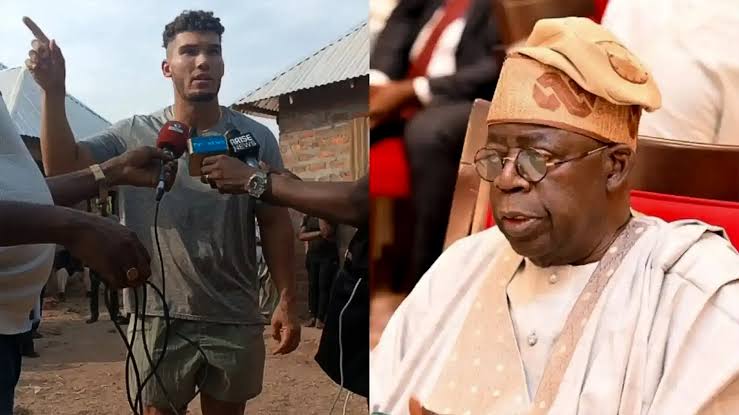
 The Federal Government has expelled American missionary Alex Barbir, citing concerns that his public statements were aggravating already fragile security conditions in Nigeria’s North-Central region. The decision, confirmed on Monday by presidential aide Abiodun Essiet, underscores a growing sensitivity within government circles to narratives seen as capable of inflaming ethno-religious tensions—particularly in volatile areas like Jos.
Essiet, who serves as Senior Special Assistant to President Bola Tinubu on Community Engagement (North Central), said the expulsion followed an internal review of Barbir’s engagements and their impact on local communities. According to her, authorities concluded that his rhetoric risked deepening divisions and potentially triggering violence.
“He has been removed and sent out of the country because of the work he’s doing, which is creating division,” she said in an interview.
Allegations of Provocative Speech
Central to the government’s case is an allegation that a speech delivered by Barbir in Jos was followed by a deadly incident involving two Muslim victims. While officials link the timing of the attack to his remarks, no independent evidence has yet publicly established a direct causal connection.
What is clear, however, is that Barbir’s framing of Nigeria’s security crisis—frequently described by him as a “war”—had begun to unsettle officials and some analysts. In a country where religious and ethnic fault lines remain politically and socially sensitive, such language is often viewed as capable of escalating fear and mistrust.
Barbir has rejected the accusations, describing them as false and politically motivated. In a video response, he defended his record, insisting his humanitarian work should outweigh criticisms of his public commentary.
Humanitarian Work Meets Political Sensitivity
Before his expulsion, Barbir had built a notable presence in parts of Benue State and Plateau, areas repeatedly hit by communal violence. His interventions included rebuilding homes, supporting displaced families, and delivering basic infrastructure in underserved communities.
In Yelwata—one of several communities affected by attacks in 2025—his team reportedly helped reconstruct damaged homes and provided relief to residents struggling to recover. Local accounts suggest that in some instances, his efforts filled gaps left by slow or overstretched government response.
This dual identity—humanitarian actor and outspoken critic—appears to have placed him on a collision course with authorities. While supporters argue he amplified the plight of victims to a global audience, critics say his framing of the crisis risked simplifying complex conflicts into religious binaries.
A Familiar Pattern of Tension
Nigeria has historically maintained a cautious stance toward foreign actors operating in sensitive security environments. From aid organisations to religious missions, external involvement is often welcomed for its resources but scrutinised for its messaging.
The North-Central region, sometimes described as Nigeria’s “Middle Belt,” has long been a flashpoint for farmer-herder clashes, communal disputes, and retaliatory violence. These conflicts are rarely reducible to a single cause, involving layers of land competition, migration pressures, and governance gaps. Government officials are particularly wary of narratives that cast the violence in strictly religious terms, fearing such interpretations can harden identities and provoke reprisals.
Legal Basis and Government Calculus
Legal analysts note that Nigeria retains broad powers to deport foreign nationals whose activities are deemed a threat to public order. While freedom of expression is constitutionally protected, it does not extend to speech considered capable of inciting unrest.
Essiet framed the decision as preventative rather than punitive, suggesting that authorities acted to avert further escalation at a time of heightened tension.
“We don’t want individuals to come and create division,” she said, warning against rhetoric that could push communities toward wider conflict.
What This Means for Citizens
For residents of affected states, the episode highlights a deeper issue: the struggle over who controls the narrative of Nigeria’s insecurity. Competing accounts—government, local, and international—shape not only public perception but also policy responses and humanitarian intervention.
The expulsion may reassure some communities that authorities are taking steps to manage inflammatory discourse. However, it also raises concerns about the space for independent voices, especially those documenting conditions in conflict zones.
What Is Known—and What Isn’t
What is confirmed is that Barbir has been removed from Nigeria and that the government views his activities as harmful to national cohesion. What remains unverified is the extent to which his statements directly influenced specific acts of violence, including the incident cited in Jos.
There is also no evidence linking him to any criminal activity beyond the allegations tied to his speech.
What to Watch Next
The immediate question is whether the government’s action will ease tensions in Plateau and neighbouring states or simply shift the debate elsewhere. Attention is also likely to turn to how authorities engage other foreign and local actors operating in conflict zones.
More broadly, the episode signals a tightening boundary around public discourse on insecurity—one that could shape how Nigeria balances national unity, free expression, and the urgent need to address violence affecting ordinary citizens.