









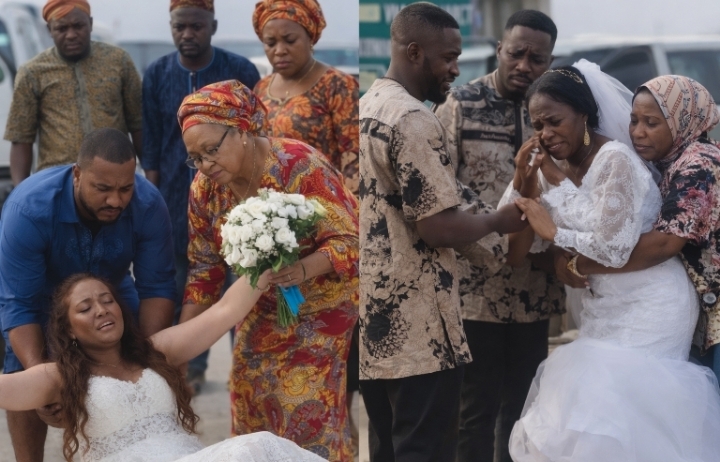
 A wedding in Lagos reportedly collapsed in dramatic fashion after a bride confessed—just hours before the ceremony—that she was four months pregnant for her fiancé’s best man. The account, which surfaced on X (formerly Twitter), has since triggered widespread debate, not only about infidelity but about the pressures surrounding modern Nigerian weddings and the cost—financial and emotional—of last-minute truth.
A Celebration Years in the Making, Gone in Minutes
According to the viral post, the groom had committed an estimated ₦31 million to what was intended to be a high-profile celebration. The event featured the now-familiar markers of a “big Lagos wedding”: coordinated aso-ebi, a fully booked venue, and extensive catering reportedly involving four cows.
Guests were already preparing to attend. Pre-wedding photos showed a smiling bride in a custom lace outfit. By all outward appearances, the ceremony was proceeding as planned.
Then, at 7:03 a.m. on the wedding day, a voice note reportedly landed in a family group chat.
“I can’t do this. I’ve been pregnant for 4 months and it’s not his,” the bride allegedly said.
The Confession and Its Immediate Fallout
What followed, based on the same account, was confusion, shock, and a rapid escalation of tension among both families. The bride’s mother reportedly demanded to know the identity of the father.
The answer—“It’s your best man. We’ve been seeing each other since the introduction”—added another layer of betrayal that cut across both romantic and social trust.
Witnesses, as described in the post, claimed the best man attempted to leave quietly as the news spread. Meanwhile, guests arriving at the venue reportedly began recording the unfolding drama, underscoring how quickly private crises can become public spectacle in the age of smartphones.
The ceremony never held. The Master of Ceremony eventually announced its cancellation, while security personnel were said to have intervened as tempers flared between both families. The groom reportedly collapsed during the ordeal, though this detail, like others in the account, remains unverified.
What Is Known—and What Isn’t
At the time of writing, the story exists primarily as a social media narrative. The identities of those involved have not been publicly confirmed, and no official statements have been issued by the families or vendors allegedly connected to the event.
This raises a familiar caution: viral accounts, particularly those involving sensational personal drama, are often difficult to independently verify. Yet their impact—on public discourse and social norms—is real.
Why This Story Resonates Now
Beyond the shock value, the incident taps into deeper anxieties about relationships, trust, and the rising cost of weddings in Nigeria.
In cities like Lagos and Abuja, weddings have increasingly become high-stakes social performances. Families often invest heavily—financially and reputationally—in ceremonies that signal status and stability. The reported ₦31 million price tag, while extreme, reflects a broader trend where couples feel pressure to meet escalating expectations.
When such events collapse, the consequences are not just emotional but economic. Vendors go unpaid, families absorb losses, and social standing can take a hit in tightly knit communities.
For ordinary Nigerians, the story also raises uncomfortable questions: How well do couples know each other before marriage? And how much truth is suppressed under the weight of cultural and familial expectations?
The Cost of Late Truth
The timing of the alleged confession has divided opinion. Some argue the bride’s decision—however painful—prevented a deeper crisis that might have emerged years into the marriage, possibly involving paternity disputes or legal battles.
Others see it as an avoidable disaster, questioning why the truth surfaced only at the final hour, after substantial financial commitments had already been made.
Relationship experts often note that delayed honesty tends to amplify damage. In Nigeria, where marriage is not just a union of individuals but of families, the ripple effects can be far-reaching.
What Happens Next?
If the account is accurate, several consequences are likely. Financial disputes may arise over deposits and payments. Personal relationships—between the couple, the families, and the best man—could fracture permanently.
There is also the less visible aftermath: emotional trauma, social stigma, and the long process of rebuilding trust and reputation.
Legally, there may be little recourse unless contractual obligations with vendors are contested. Socially, however, the fallout could linger far longer than the one-day event that never happened.
A Mirror to Society
The viral narrator ended with a question that continues to circulate: is it better to uncover such a truth on the wedding day or years into a marriage?
There is no easy answer. But the incident, whether fully verified or not, highlights a tension many Nigerians recognise—the gap between the image of a perfect wedding and the reality of imperfect human relationships.
As wedding culture continues to grow in scale and cost, this story serves as a stark reminder: beneath the spectacle, the success of a marriage still rests on something far less visible—and far less negotiable—than the event itself.