






![Viral House Party Video Sparks Conversation on Changing Social Norms Among Nigerian Mothers [Watch Video]](https://kumornews.com/wp-content/uploads/2026/02/Viral-House-Party-Video-Sparks-Conversation-on-Changing-Social-Norms-Among-Nigerian-Mothers-Watch-Video-1-360x180.jpg)


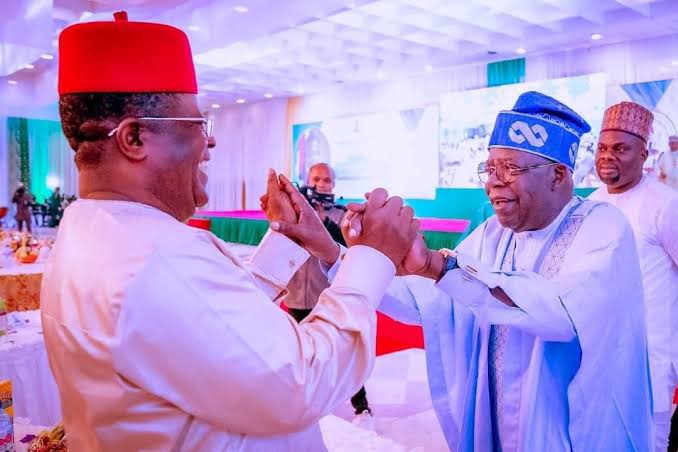
At a routine infrastructure commissioning in Enugu, Minister of Works Dave Umahi moved beyond roads and bridges into overt political messaging—framing President Bola Tinubu’s leadership in spiritual terms while urging Southeast leaders to close ranks ahead of the 2027 election cycle.
Speaking at the inauguration of the Eke Obinagu–Emene flyover, Umahi said he had received what he described as a divine revelation affirming Tinubu’s presidency. “God has spoken to me that His mighty hands are upon President Bola Tinubu,” the minister said, according to remarks delivered at the event.
The statement, while personal in tone, quickly took on political weight as Umahi linked it to a broader call for Southeast alignment with the current administration.
From Infrastructure to Political Messaging
The flyover commissioning was expected to highlight federal infrastructure spending in the region. Instead, it became a platform for a more strategic argument: that the Southeast’s long-standing complaints of marginalisation are being addressed under Tinubu’s government.
Umahi argued that, since 2023, the region has gained increased visibility in federal appointments and decision-making. “For the first time, we’re in the helm of affairs,” he said, urging political actors in the zone to recognise and consolidate that position.
He went further, calling on Southeast leaders to openly campaign for Tinubu’s re-election. “If you’re a leader in the Southeast and you’re not vocal… then you’re not for us,” he added.
A Shift in Southeast Political Strategy?
Umahi’s remarks reflect a noticeable shift in tone from a region that has, in recent election cycles, largely backed opposition candidates at the presidential level. In 2023, voting patterns across the Southeast underscored deep dissatisfaction with the ruling party, driven by perceptions of exclusion and uneven federal investment.
Historically, the marginalisation narrative has been central to Southeast political identity—rooted in post-civil war grievances and reinforced by debates over federal appointments, infrastructure deficits and security responses.
Umahi, a former governor of Ebonyi State, has in recent years positioned himself as a bridge between the region and the federal centre. His latest comments suggest an attempt to reframe engagement with Abuja not as compromise, but as strategy.
Religion and Politics: A Familiar Intersection
Invoking divine endorsement in Nigerian politics is not new. Politicians across party lines have frequently used religious language to legitimise authority or mobilise support in a country where faith plays a central role in public life.
However, such statements can be double-edged. While they resonate with religious constituencies, they also risk blurring the line between personal belief and public policy—particularly in a multi-religious society where political legitimacy is expected to rest on performance and accountability.
Umahi did not provide details on the “revelation” he referenced, and there is no independent verification of such claims. The presidency has not issued an official response to his remarks as of the time of reporting.
What This Means for Ordinary Citizens
For many residents in the Southeast, the immediate concern is less about political alignment and more about tangible outcomes—roads, jobs, security and economic stability.
Federal infrastructure projects, such as the newly commissioned flyover, are often cited by government officials as evidence of inclusion. But analysts note that public perception tends to hinge on consistency and scale, not isolated projects.
Umahi’s call for political unity behind Tinubu may therefore face a practical test: whether increased support for the administration translates into measurable improvements in daily life.
Looking Ahead to 2027
Although the next presidential election is still over a year away, political positioning has already begun. Umahi’s comments can be read as part of an early effort to reshape the electoral map by weakening opposition strongholds and building cross-regional alliances.
His suggestion that Southeast leaders should support Tinubu now to strengthen the region’s chances of producing a future president also introduces a longer-term calculation—one that may appeal to political elites but requires broader public buy-in.
For now, reactions within the region remain mixed, with some viewing the remarks as pragmatic and others as premature.
What is clear is that the conversation around the Southeast’s place in national politics is evolving. Whether Umahi’s intervention marks a turning point—or simply another episode in a long-running debate—will depend on what follows: policy delivery, political negotiations and, ultimately, voter sentiment.