




![Viral House Party Video Sparks Conversation on Changing Social Norms Among Nigerian Mothers [Watch Video]](https://kumornews.com/wp-content/uploads/2026/02/Viral-House-Party-Video-Sparks-Conversation-on-Changing-Social-Norms-Among-Nigerian-Mothers-Watch-Video-1-360x180.jpg)





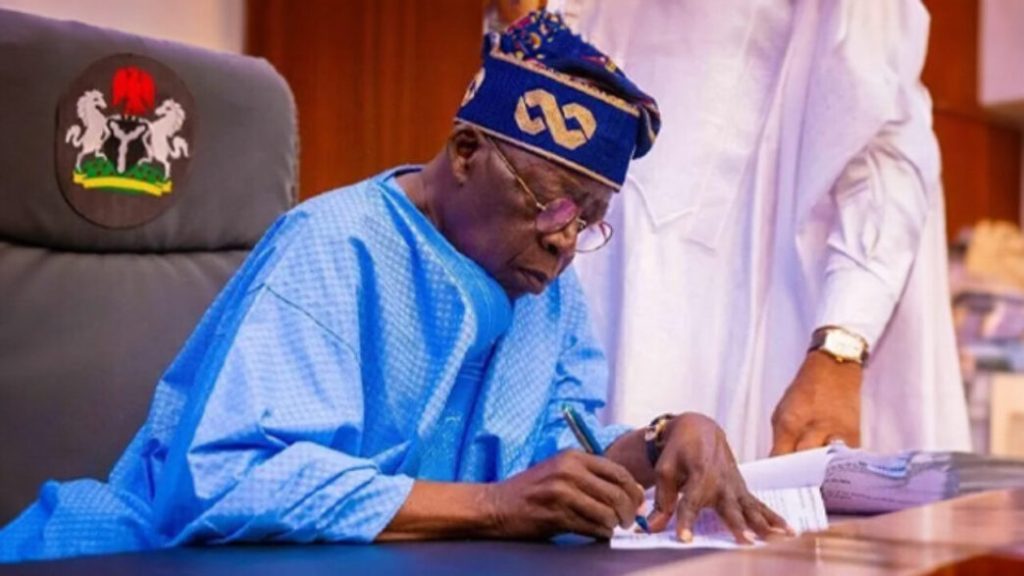
President Bola Ahmed Tinubu on Wednesday signed the Electoral Act 2026 (Amendment) Bill into law, describing the legislation as a necessary intervention to stabilise Nigeria’s electoral framework ahead of the 2027 general elections.
The assent, carried out at the Presidential Villa in Abuja, followed months of legislative deliberations by the National Assembly of Nigeria, with senior lawmakers and top administration officials present, including Senate President Godswill Akpabio and Speaker of the House of Representatives Tajudeen Abbas.
Speaking shortly after signing the bill, Tinubu framed the amendment as part of broader efforts to strengthen democratic confidence at a time when public trust in Nigeria’s electoral process remains fragile.
Focus on Election Credibility and System Reliability
At the centre of the amendment is a clarification of how election results should be handled when electronic transmission fails — an issue that generated intense political controversy during recent elections.
Under the new law, results recorded on the manually completed Form EC8A at polling units will serve as the primary basis for collation and declaration where electronic transmission to the Independent National Electoral Commission (INEC) portal is disrupted by network or communication challenges.
Tinubu acknowledged ongoing debates around technology-driven elections, questioning Nigeria’s digital preparedness while defending the continued relevance of manual voting procedures.
According to the President, democracy ultimately depends on human oversight rather than technology alone, noting that votes are still cast, counted, and validated physically at polling units before any electronic transmission occurs.
His remarks signal an official policy balance: retaining technological transparency while legally safeguarding manual processes against system failures or cyber interference.
Background: Lessons From Recent Electoral Disputes
Nigeria’s electoral reforms have increasingly revolved around electronic accreditation and result transmission since amendments introduced before the 2023 general elections. While digital tools such as the Bimodal Voter Accreditation System (BVAS) were designed to improve transparency, technical glitches and delayed uploads triggered post-election disputes and litigation across several states.
Opposition parties and civil society groups had argued that inconsistencies between polling-unit results and uploaded data undermined public confidence. The latest amendment appears aimed at closing that legal grey area by clearly defining which record takes precedence during transmission failures.
In practical terms, lawmakers are attempting to prevent future elections from being invalidated or delayed solely due to connectivity problems — a persistent challenge in rural and underserved communities.
What the Amendment Means for Ordinary Voters
For voters, particularly in areas with weak telecommunications infrastructure, the amendment could reduce fears that votes may be discarded because of network outages.
Election officials will still be required to transmit results electronically where possible. However, where transmission proves impossible, signed physical result sheets endorsed by polling agents will now carry definitive legal authority.
This provision may ease operational pressure on polling officers in remote parts of the country, but analysts note it also places renewed importance on transparency at the polling-unit level, where counting and documentation occur.
In effect, credibility shifts back to on-ground supervision — party agents, observers, and citizens physically present during vote counting.
Political and Institutional Implications
Tinubu praised lawmakers for managing what he described as extensive democratic discussions without creating confusion or disenfranchisement, expressing optimism that the amendment would help democratic institutions “flourish.”
However, electoral observers are likely to scrutinise how the law is implemented rather than its wording alone. Nigeria’s election credibility challenges have historically stemmed less from legislation and more from enforcement gaps, logistics failures, and disputes over collation procedures.
The amendment therefore sets legal expectations, but its success will depend heavily on training of electoral personnel, timely deployment of materials, and real-time transparency during result collation.
What Happens Next
With the law now in force, attention shifts to the Independent National Electoral Commission, which must update operational guidelines, technology protocols, and training manuals before the 2027 elections cycle begins.
INEC is also expected to clarify how manual and electronic records will be reconciled where discrepancies arise — an area that could become a major legal battleground in future contests.
For Nigerians, the immediate implication is clear: while technology will remain part of elections, the legal backbone of vote declaration has firmly returned to verifiable physical documentation.
As political parties begin early positioning for 2027, the effectiveness of this amendment may ultimately be judged by a single measure — whether it restores voter confidence in the finality and fairness of election results.



![Viral House Party Video Sparks Conversation on Changing Social Norms Among Nigerian Mothers [Watch Video]](https://kumornews.com/wp-content/uploads/2026/02/Viral-House-Party-Video-Sparks-Conversation-on-Changing-Social-Norms-Among-Nigerian-Mothers-Watch-Video-1-75x75.jpg)